When Matter Learns to Move
Begin with air before it disappears. In Dohee Park's Carving Air, breath is not background atmosphere but a sculptural force. Art & Materials Lab describes the work as translating repetitive anxiety into forms that tighten, crack and rebound, with hidden elastic mechanisms restoring structure after stress. The object appears still only after movement has done its work. A surface holds the memory of pressure, as a chest might hold the after-sensation of a difficult breath.
The September question is this: how does matter learn to move? Not by becoming kinetic in an obvious way, and not only by showing literal motion. Matter learns to move when a process leaves an instruction inside it: stretch here, bend there, carry weight, resist water, remember abrasion, return after strain. To read these works, start by asking what force has passed through the material and what trace that force has left behind.
This is also a question of perception. A reader or viewer often arrives after the making is complete, when the object has quietened. The task is to reconstruct the earlier movement from evidence: a fracture line, a softened edge, a repeated fibre, a polished hollow, a surface that seems to breathe or buckle. Material criticism begins with those clues. It treats the finished work less as a closed result than as a paused sequence of actions.
Carving Air makes that reading intimate. Breath is usually treated as invisible, private and temporary. Park gives it consequence. The cracks and rebounds described in the work suggest a form repeatedly pushed towards failure and pulled back into shape. Gernot Bohme's writing on atmosphere is useful here because it treats space and sensation as something produced between bodies, objects and surroundings. In Carving Air, air becomes more than emptiness. It is a condition that presses on the body and can be felt through material tension.
That tension matters because comfort rituals can injure as well as soothe. A repeated gesture may calm the hand while marking the surface. A hidden mechanism may restore form while leaving the viewer aware of stress. The work does not simply illustrate anxiety. It teaches the viewer to look for where pressure has been stored.
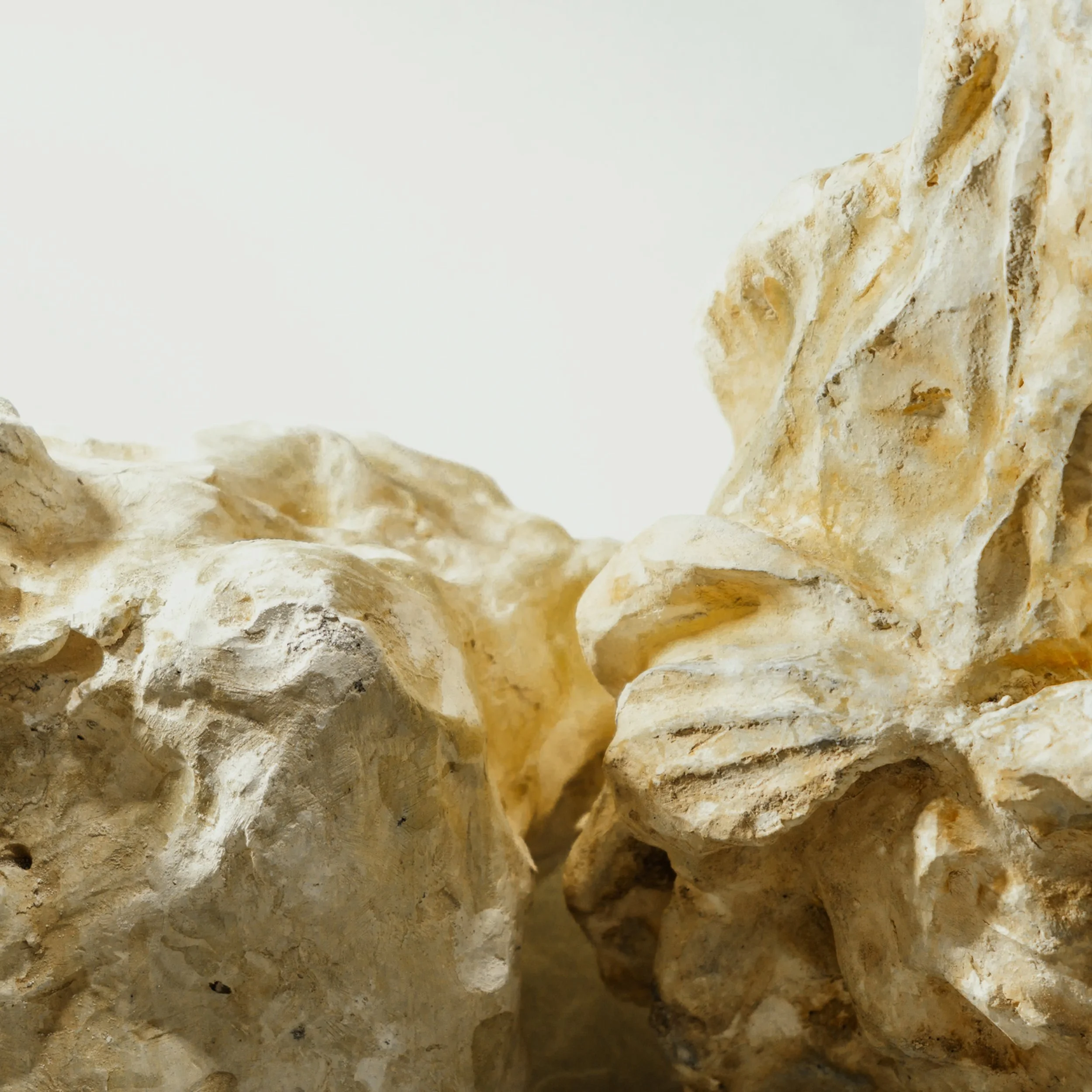
Carving Air by Dohee Park
Mizzi Studio's The Living Bridge shifts movement from the nervous body to shared passage. The project, created with Green School Bali, is described by Art & Materials Lab as a collaborative bridge made of bamboo, terrazzo, and mycelium, co-created by students, teachers, and Mizzi Studio. A bridge is a simple proposition only from a distance. Up close, it is a negotiation among span, load, material availability, maintenance, weather, and daily crossings.
Bamboo is especially suited to this kind of argument because it is not just a symbol of ecological design. Walter Liese and Michael Kohl describe bamboo as a plant material whose strength and behaviour depend on species, age, culm position, moisture and treatment. Its usefulness comes from knowledge, not from greenness alone. The Living Bridge should therefore be read as a learning structure as much as a crossing. Its materials are taught by being walked over, repaired, touched and discussed by the school community.
There is an important difference between a bridge as an image and a bridge as a habit. A photographed bridge may look complete. A live bridge is tested every morning. Feet, rain, humidity and repair turn design into a repeated event. Albena Yaneva's ethnographic approach to architecture helps here: buildings are not only finished objects, but networks of decisions, models, materials and negotiations. The Living Bridge remains in motion because people keep using it.

The Living Bridge by Mizzi Studio
Sitong Chen's FLOW brings the article to jewellery, where movement is compressed into a smaller scale. Art & Materials Lab describes the project as a water-led metal jewellery series that translates flowing, freezing, erosion, and mineralisation into wearable sculptures through enamelling, chasing, and hollow-forming. The phrase "water-led metal" is worth slowing down over. Metal is hard, bright and resistant; water is fluid, dissolving and persistent. Chen's work sets those behaviours against one another.
Chasing pushes metal from the surface. Hollow-forming makes volume without solid mass. Enamelling adds a glass-like skin through heat. None of these processes simply decorates the object; each records an action. Juhani Pallasmaa's writing on the hand and embodied experience is relevant because jewellery is never only visual. It has temperature, weight and pressure. FLOW asks the wearer to sense water through a material that is not water, and to recognise erosion as a worked surface rather than a distant geological event.
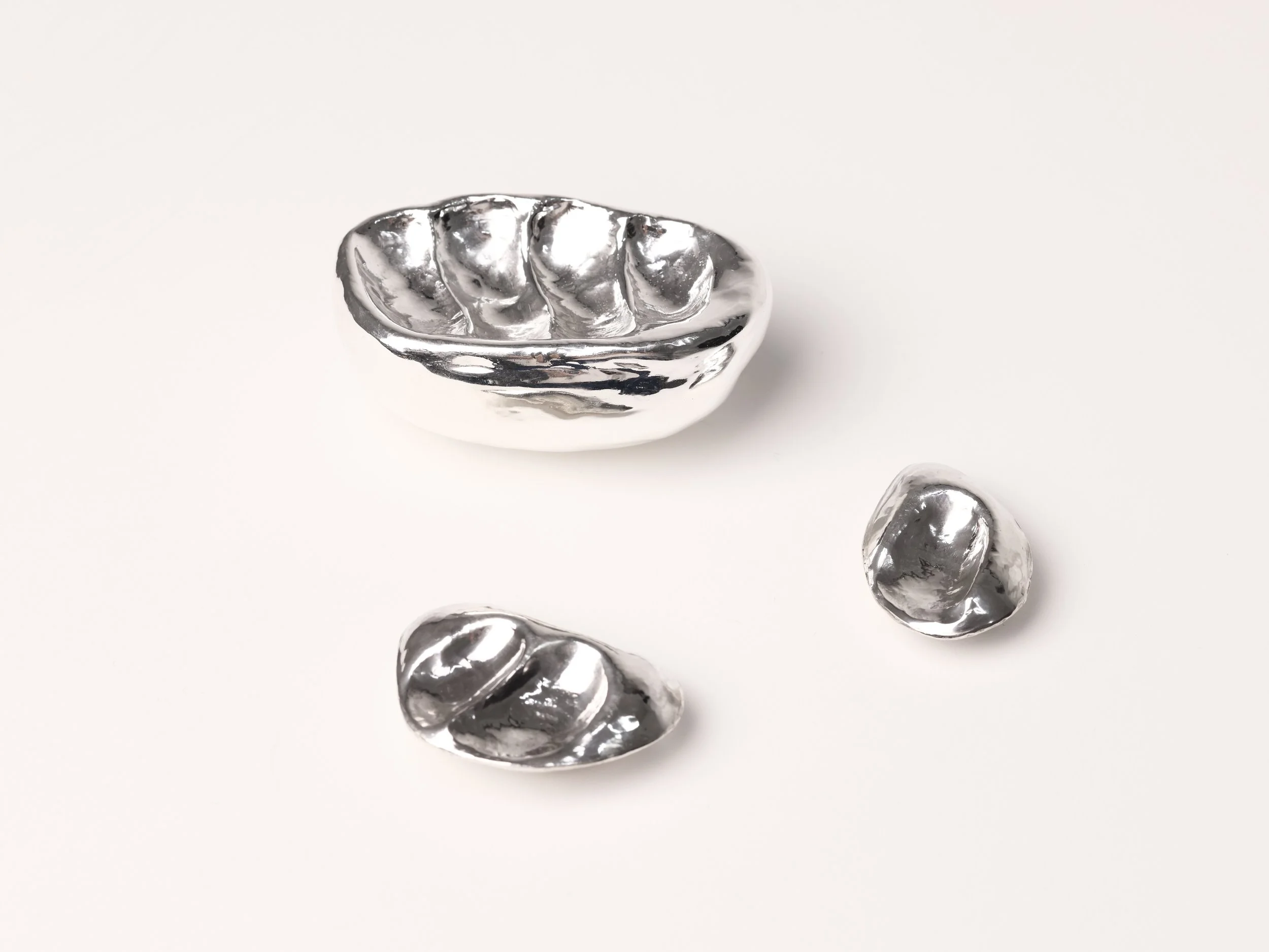
FLOW by Sitong Chen
Cuecos by DESIGNO-Patagonia moves from water as image to water as maker. The collection is described by Art & Materials Lab as handcrafted kitchen and home containers inspired by the transformation of natural materials, using locally sourced lenga wood, river pebbles, and eco-conscious packaging. A river pebble is not smooth by intention. It is shaped by collision, current and time. Research by Domokos and colleagues on river-rock rounding describes how abrasion can round edges before significantly reducing size, helping explain why a pebble can look calm while recording a violent history of contact.
That geological lesson changes how the domestic object reads. A pebble beside refined wood is not a decoration borrowed from nature. It is a slow tool of evidence. The wood, too, has been altered by cutting, sanding and touching. Cuecos places river time and hand time in the same object. It asks the kitchen or home container to carry a small argument about use: holding, storing and serving are material acts shaped by bodies and environments.

Cuecos by DESIGNO-Patagonia
Across the four works, movement appears in different registers. Park begins with breath and rebound. Mizzi Studio turns crossing into a structure. Chen translates water into metal behaviour. DESIGNO-Patagonia lets river abrasion and hand refinement meet in the domestic sphere. What connects them is not a single material but a way of reading: do not ask only what the thing is made of; ask what has moved through it.
This is a useful discipline for material culture because stillness can be deceptive. The solid thing may be the last stage of a long sequence of flows, stresses, impacts and repairs. Tim Ingold warns against treating materials as inert substances waiting for form to be imposed on them. Materials have tendencies. They bend, dry, crack, oxidise, absorb, resist and wear. The artist or designer works with those tendencies, not above them.
The final image is a set of paused motions: air tightened into a cracked surface; bamboo carrying footsteps over a school landscape; metal remembering water through enamel, hollow and chase marks; a river pebble resting beside worked wood. Matter has not stopped moving. It has only slowed enough for us to read it.
Bibliography
Art & Materials Lab (2026) 'Carving Air - Dohee Park'. Available at: https://www.artandmaterialslab.com/art/carvingair-doheepark (Accessed: 05 September 2026).
Art & Materials Lab (2026) 'The Living Bridge - Mizzi Studio'. Available at: https://www.artandmaterialslab.com/spatial/thelivingbridge-mizzistudio (Accessed: 15 September 2026).
Art & Materials Lab (2026) 'FLOW - Sitong Chen'. Available at: https://www.artandmaterialslab.com/materials/flow-sitongchen (Accessed: 13 September 2026).
Art & Materials Lab (2025) 'Cuecos - DESIGNO-Patagonia'. Available at: https://www.artandmaterialslab.com/materials/cuecos-designopatagonia (Accessed: 05 September 2026).
Bohme, G. (2017). The Aesthetics of Atmospheres. London: Routledge.
Domokos, G., Jerolmack, D.J., Sipos, A.A. and Torok, A. (2014) 'How river rocks round: Resolving the shape-size paradox', PLOS ONE, 9(2), e88657.
Ingold, T. (2013) Making: Anthropology, Archaeology, Art and Architecture. London: Routledge.
Liese, W. and Kohl, M. (2015). Bamboo: The Plant and Its Uses. Cham: Springer.
Pallasmaa, J. (2009). The Thinking Hand: Existential and Embodied Wisdom in Architecture. Chichester: Wiley.
Yaneva, A. (2009) Made by the Office for Metropolitan Architecture: An Ethnography of Design. Rotterdam: 010 Publishers.
Responsible Editor
Isabel Pavone