What Does a Material Remember?
A pigment grain is already a small archive. Before it becomes colour, it has been ground, lifted, mixed, slowed by liquid, pulled by gravity and caught by a surface. In Stardust Painting, Rino and Kaito Tokito work with mineral pigments and stone powders that move through flow, sedimentation and drying before being sealed in resin. The result is jewellery, but the scale should not mislead us. Each pendant or small form behaves like a held weather system: a record of movement made portable.
The August question is this: what does a material remember? Not in a sentimental sense, as if matter secretly thinks. Material memory is more practical than that. It is the evidence left by pressure, heat, growth, touch, chemistry, labour and time. To read it, begin with three instructions. Look for the process that changed the material. Look for the trace that process left behind. Then ask who is being invited to notice it.
Stardust Painting makes chance visible without abandoning craft. Art & Materials Lab describes mineral-derived pigments and powdered stone coaxed through gravity, flow, sedimentation and drying, then sealed in resin with brass and occasional pearls. The artists do not paint a fixed image onto an inert ground. They set conditions, then allow materials to register their own behaviour. The resin becomes preservation and interruption at once: it holds the mineral accident still, but also turns it into a wearable object that will warm against skin and shift under light.
David Batchelor's writing on colour is useful here because it resists treating colour as secondary or cosmetic. Colour is not an afterthought applied to form; it can disturb order, carry desire, and change how the body reads an object. In Stardust Painting, colour is not simply chosen. It is negotiated with powder, liquid and time. The viewer sees a finished pendant, but the surface quietly records a prior instability.
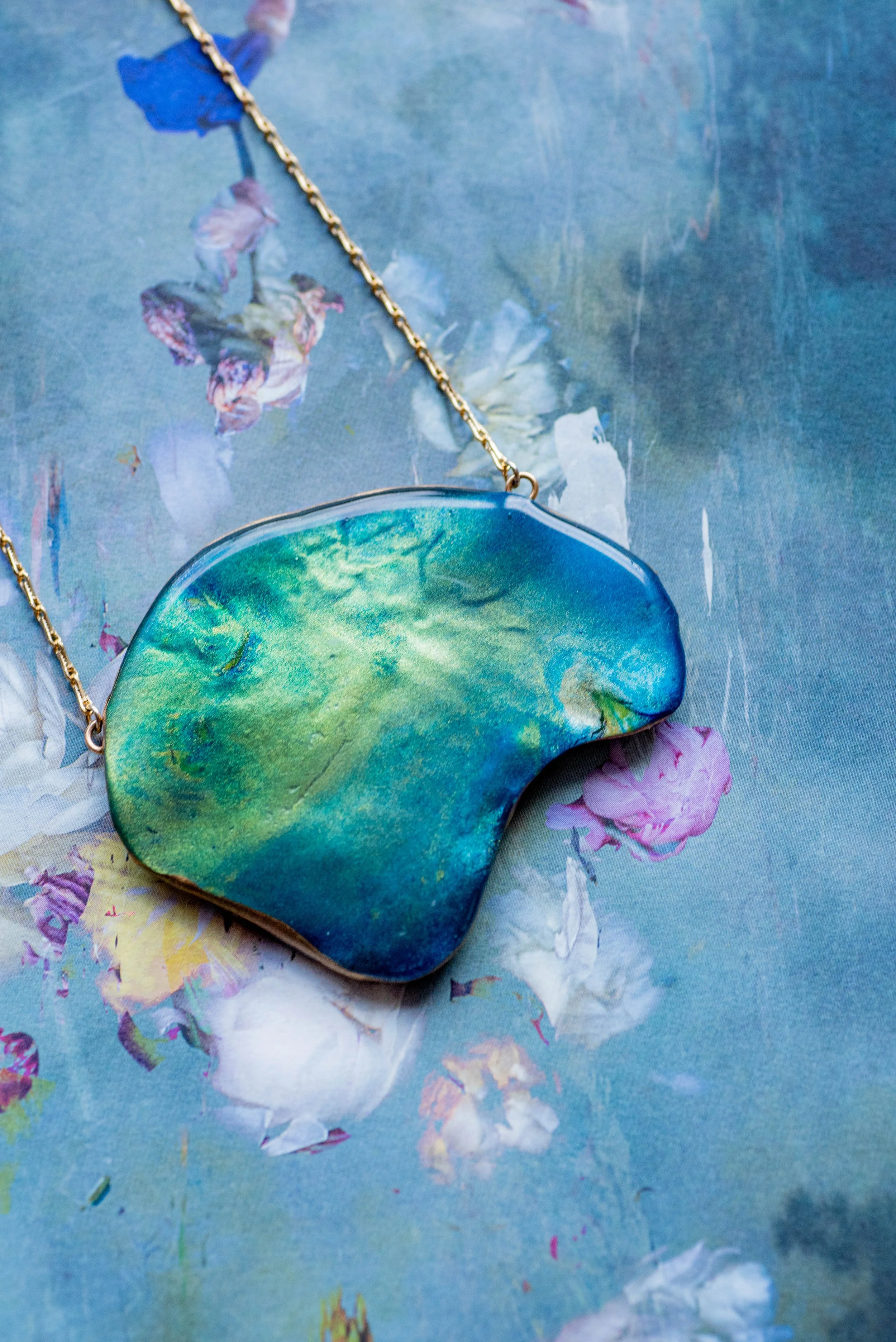
Stardust Painting by Rino and Kaito Tokito / Umi to Nasi / Leon Art Jewelry
Mathieu Nouhen's Fossile Land Art expands material memory from ornament to landscape. The work transforms a French agricultural plot into a temporary spiral of timber stakes treated with the Shou Sugi Ban technique. Charred wood carries a double message. Fire marks it, darkens it and partially consumes it; at the same time, controlled charring can protect wood surfaces by altering how the outer layer responds to moisture, insects and weather. The technique is often discussed too simply as beautiful blackening. In Fossile, its importance is temporal.
The stakes point inward, forming a fossil-like spiral in a volcanic setting. Visitors leave their own passing traces across the site, and the work's temporary nature matters. It is not trying to become a permanent monument. Simon Schama's writing on landscape and memory helps frame this: landscapes are not empty scenery but cultural constructions, layered with stories, labour and symbolic occupation. Nouhen's charred spiral adds a new layer without pretending to be the oldest one. It marks the land, then leaves the mark provisional.

Fossile Land Art by Mathieu Nouhen
SO-Colored, by Tokyo design studio we+, with Algal Bio Co., Ltd., brings the argument into the laboratory of colour. Art & Materials Lab describes microalgal pigments developed into bio-composites with natural resins, producing objects in reds, blues, yellows, and greens depending on species and environmental conditions. The project is valuable because it shifts colour away from the fantasy of stable industrial sameness. It asks us to consider colour as the outcome of living systems, cultivation and stress.
Microalgae research has long been connected to food, biofuels, pharmaceuticals and high-value compounds. Studies by Borowitzka and by Spolaore and colleagues describe microalgae as sources of commercially significant molecules, including pigments and other bioactive substances. That context does not prove every design application is automatically ecological. It does, however, show that the colour in SO-Colored belongs to a wider scientific field in which growth conditions, species selection, extraction and processing matter. The colour is not only visual; it is procedural.
This is where claims need discipline. It is tempting to call algae colour sustainable and move on. A better reading asks what must be grown, dried, transported, mixed, bound and preserved for the colour to perform. The we+ project is strongest when treated as research into the origins of colour rather than as a finished solution for synthetic dye systems. Its surfaces make a quiet demand: if colour can be grown, we must learn to read cultivation as part of aesthetics.

SO-Colored by Studio we+
Amy Hsu Tzu Chen's Exploring the Soft Resilience Within changes the register again. Her materials include galvanised wire, metallic twist ties and chenille stems, worked through weaving, looping, coiling, crochet and braiding. Art & Materials Lab describes the project as an ongoing textile and materiality research practice linked to feminine resilience, touch and public interaction. Here, memory is not sealed like resin or fixed into a landscape spiral. It is made through handling.
Textile history helps explain why this matters. Rozsika Parker's The Subversive Stitch shows how embroidery and related hand practices have been bound up with gendered expectations, domestic labour and cultural value. Anni Albers, writing from the position of a maker, insists that weaving is a form of thinking through material constraints. Chen's work fits within this broader argument: textile methods are not merely decorative skills. They are ways of organising force, softness, repetition and social contact.
Because Chen encourages touch, the work also refuses the museum habit of distance. Pliability becomes an archive of participation. A loop can be compressed, a wire can spring back, and a chenille stem can hold a bend. The material remembers the visitor not by name or photograph, but as a temporary deformation. This kind of memory is fragile, but not weak. It shows that resilience may be a capacity to change shape without losing the thread of the structure.

Exploring the Soft Resilience Within by Amy Hsu Tzu Chen
Across these four works, material memory is never a single thing. It can be mineral sediment sealed into jewellery, charred timber arranged across a field, algae colour carried into resin, or flexible matter altered by touch. What connects them is not appearance but method. Each asks us to slow down and read the evidence: the flow line, the burn mark, the biological pigment, the bend. Each work turns matter into a record of relations between human intention and material behaviour.
The closing image is not an archive box or a database. It is smaller and more physical: a resin surface holding powdered stone mid-drift; a blackened stake catching light on a slope; an algae-coloured object keeping a trace of growth; a twisted strand reshaped by a hand and not quite returning to where it began. Material memory starts there, in the marks that remain after matter has been asked to respond.
Bibliography
Albers, A. (1965). On Weaving. Middletown, CT: Wesleyan University Press.
Art & Materials Lab (2026) 'Stardust Painting - Rino and Kaito Tokito'. Available at: https://www.artandmaterialslab.com/art/stardustpainting-rinoandkaitotokito (Accessed: 25 June 2026).
Art & Materials Lab (2024) 'Fossil Land Art - Mathieu Nouhen'. Available at: https://www.artandmaterialslab.com/spatial/fossile-land-art-mathieunouhen (Accessed: 25 June 2026).
Art & Materials Lab (2025) 'SO-Colored - We+'. Available at: https://www.artandmaterialslab.com/materials/socolored-we (Accessed: 25 June 2026).
Art & Materials Lab (2025) 'Exploring the Soft Resilience Within - Amy Hsu Tzu Chen'. Available at: https://www.artandmaterialslab.com/materials/exploring-thesoft-resiliencewithin (Accessed: 25 June 2026).
Batchelor, D. (2000) Chromophobia. London: Reaktion Books.
Borowitzka, M.A. (2013) 'High-value products from microalgae - their development and commercialisation', Journal of Applied Phycology, 25, pp. 743-756.
Parker, R. (1984) The Subversive Stitch: Embroidery and the Making of the Feminine. London: The Women's Press.
Schama, S. (1995) Landscape and Memory. London: HarperCollins.
Spolaore, P., Joannis-Cassan, C., Duran, E. and Isambert, A. (2006) 'Commercial applications of microalgae', Journal of Bioscience and Bioengineering, 101(2), pp. 87-96.
Wallpaper* (2025) 'Tokyo design studio We+ transforms microalgae into colours'. Available at: https://www.wallpaper.com/design-interiors/tokyo-design-studio-we-transforms-microalgae-into-colours (Accessed: 25 June 2026).
Responsible Editor
Tom Wilson