Surfaces That Teach the Hand
Begin with the part of the object that meets you first. Not the concept, not the caption, not the promise of sustainability, but the surface: a glint of silver, a blur of bamboo fibre, a glaze that pools at an edge, a translucent film pressed around soap. A surface is often dismissed as appearance, as if it arrives after the serious work of structure and material has been completed. These four works suggest the opposite. Surface is where a material begins to instruct the body.
The question for July is simple: what does a surface teach before we understand the whole object? It teaches distance and permission. It tells the hand whether to grip, stroke, avoid, unwrap, sit, polish, wash or wait. James J. Gibson's theory of affordances is useful here because it treats perception as action-oriented. We do not only see form; we read what an environment or object offers us. A surface is one of the first places where that offer becomes legible.
Airy Chen's Self Portrait, made for her jewellery brand Reflection, uses sterling silver to stage that encounter between seeing and being seen. Art & Materials Lab describes rings that contrast matte and polished finishes, hollow and solid forms, open and closed eyes. Silver is not only a precious material here. It is a perceptual instrument. A polished area catches light and reflects it; a matte area holds light in a softer, more private way. The difference matters because the work is built around the psychology of reflection and the inner child.
To read these pieces materially, start with the finish. A mirror-like surface does not simply decorate the ring; it implicates the wearer. The finger carries a small reflective architecture, one that turns looking into a loop. The hollow silhouette and eye motif make the body aware of being both subject and observer. Juhani Pallasmaa's writing on the hand and the senses helps clarify this point: touch and sight are not separate channels in designed experience. A ring is seen, but it is also felt as pressure, temperature and weight. In Self Portrait, self-knowledge becomes staged at the level of the skin.

Self Portrait by Airy Chen
Arashi Abe's Take Higo Stool also begins with a surface that misleads productively. Art & Materials Lab entry describes a stool made from 399 strands of 3.0 mm bamboo and 252 strands of 1.8 mm bamboo, bound with hemp twine and water-based wood glue. From some angles, the stool appears fuzzy or static, as if its outline has not yet settled. Yet the object is still a stool, a thing that must answer the body with support.
This tension between optical softness and structural work is the piece's strongest lesson. Bamboo is often praised too quickly as a green material, but its real intelligence lies in anatomy and technique: long fibres, hollow culms, splitting, bending, binding, drying. Walter Liese and Michael Kohl describe bamboo as a plant material whose properties vary by species, age, moisture and treatment. Abe does not treat bamboo as a generic eco-symbol. He breaks it down into slender strands and lets repetition create both strength and visual uncertainty.
The stool teaches the viewer to distrust first impressions. What looks like fuzz may be disciplined alignment. What appears delicate may be load-bearing. The hemp twine is not hidden; it participates in the surface, turning the joint into a visible rhythm. This is where craft becomes instructional. The eye follows the repeated line, then the body imagines sitting. Surface becomes a rehearsal for trust.

Take Higo Stool by Arashi Abe
Studio Peipei's Recycled Glaze moves the discussion from fibre to fired skin. The project turns recycled stone dust from workshops into ceramic glaze, with colour and texture changing according to the stone source. This matters because glaze is often treated as the final beautifying layer on a ceramic body. In fact, glaze is chemistry, geology and heat made visible. Daniel Rhodes's classic writing on clay and glazes reminds us that fired surfaces depend on silica, alumina, fluxes, temperature and atmosphere. A glaze is not paint. It is a thin mineral event.
Recycled Glaze is persuasive when read as an archive of dust. Stone waste is normally a by-product of cutting, carving and polishing elsewhere. Peipei returns that residue to the surface, where it becomes colour, texture and variation. The claim needs careful fact-checking before publication, especially regarding water and energy use, certifications, and production volume. But the material question is strong: what if a surface could carry the record of another workshop's subtraction? A tile or vessel glazed with recycled stone dust not only shines. It remembers abrasion.
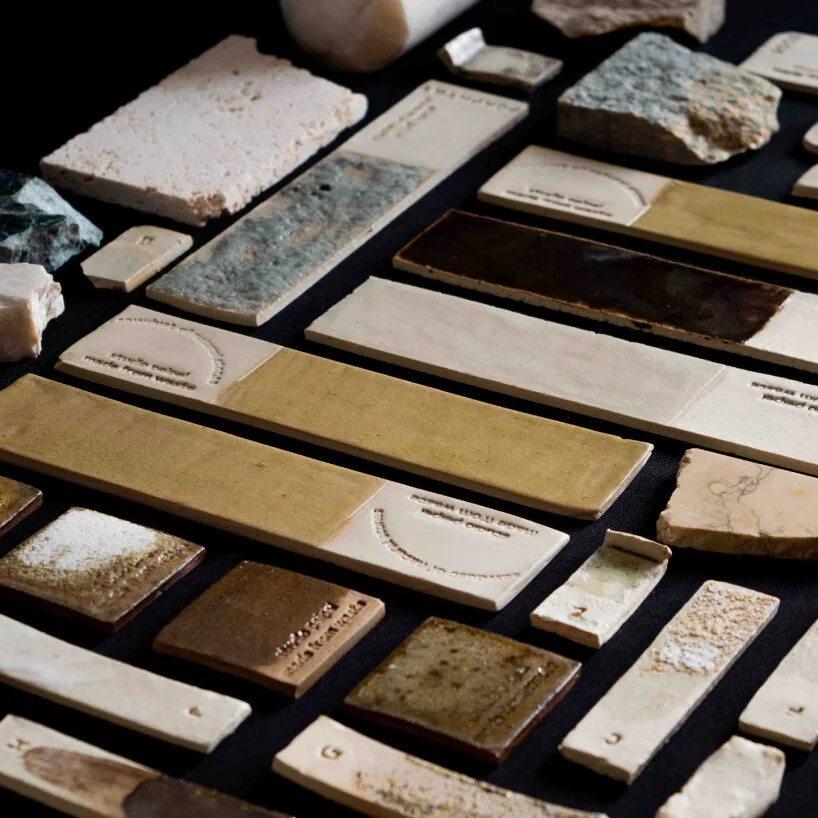
Recycled Glaze by Studio Peipei
Alara Ertenu's Packioli offers the most temporary surface in this group. Made from discarded artichoke leaves and pea pods, the bio-wrap is described as heat-sealable packaging for soap, tinted with plant pigments and designed to resist water briefly before biodegrading in water over roughly 10 to 15 days. Here, the surface has a narrow assignment. It must protect the soap from dirt and moisture, survive handling and shipping, and then surrender its integrity after use.
Packaging is an ethical problem because its surface often conveys confidence while hiding disposal. Gordon Robertson's work on food and packaging principles is useful even beyond food: packaging must contain, protect, communicate and suit distribution. Packioli accepts those practical demands instead of pretending that ecological intention is enough. Its seam, translucency, and water response serve as evidence of calibration. Too weak, and it fails as packaging. Too durable, and it repeats the problem it's meant to solve.
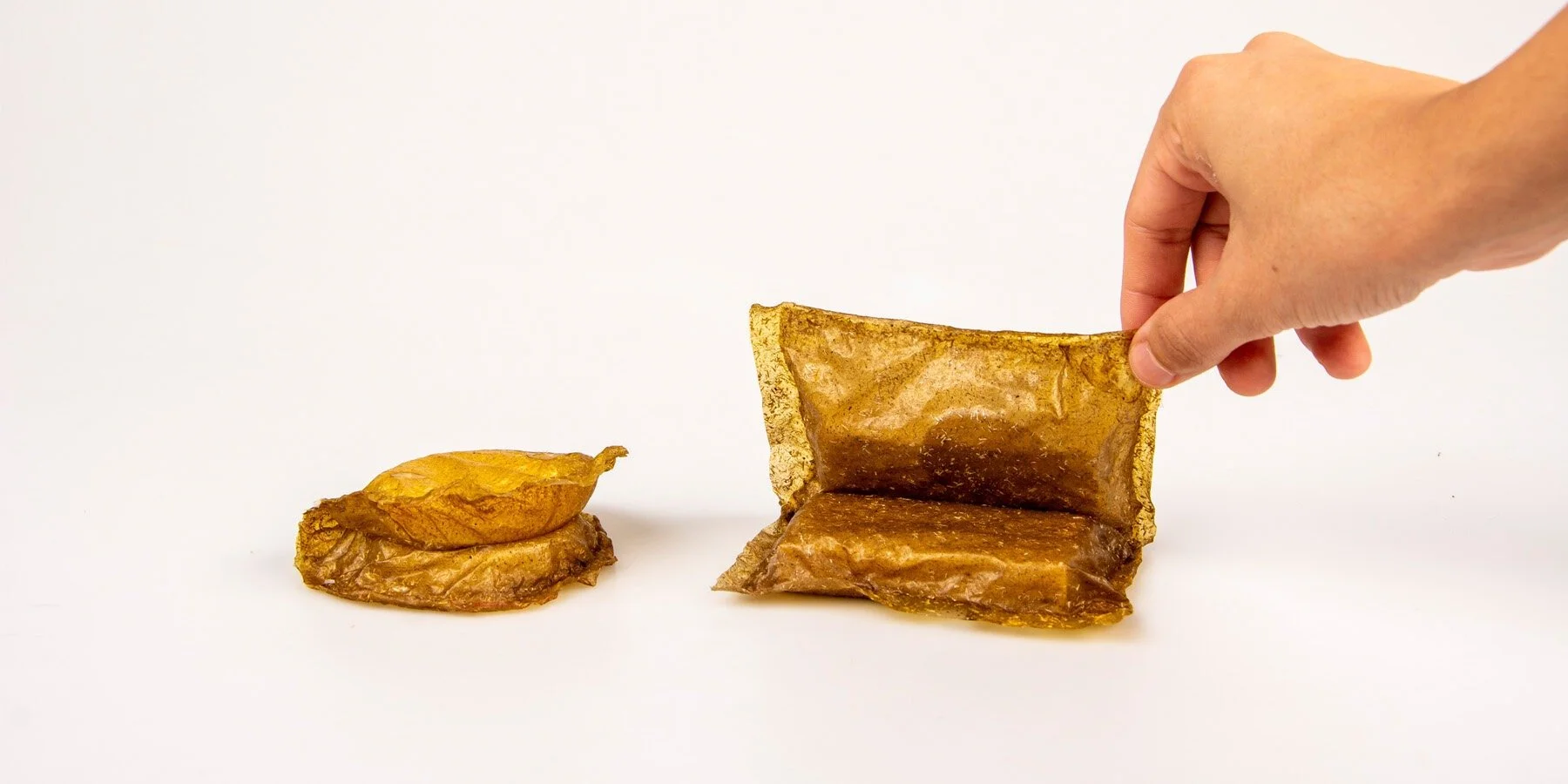
Packioli by Alara Ertenü
Tim Ingold warns against treating materiality as an abstract property detached from material processes. That warning belongs with all four works. Silver is not simply reflective; it is polished, worn and warmed by the body. Bamboo is not simply natural; it is split, counted, tied and stressed. Stone dust is not simply waste; it is collected, formulated and fired. Plant residue is not simply biodegradable; it is processed into a film whose performance must be measured in use.
Read together, these works make the surface into a research method. First, look for what the surface asks the body to do. Second, trace how the surface was produced. Third, ask for the evidence that supports its promise. Fourth, notice what the surface remembers: skin, fibre, quarry, field, workshop, bathroom, hand. This is not a decorative reading. It is a way of refusing lazy material language.
The closing image is small enough to hold: a ring flashing then dulling against a finger; bamboo lines trembling around a stool; stone dust liquefied into glaze; a soap wrapper softening at its seam. Each surface teaches before it explains. The hand receives the lesson first.
Bibliography
Art & Materials Lab (2025) 'Self Portrait - Airy Chen'. Available at: https://www.artandmaterialslab.com/art/selfportrait-airychen (Accessed: 04 July 2026).
Art & Materials Lab (2024) 'Take Higo Stool - Arashi Abe'. Available at: https://www.artandmaterialslab.com/spatial/takehigostool-arashiabe (Accessed: 04 July 2026).
Art & Materials Lab (2025) 'Recycled Glaze - Studio Peipei'. Available at: https://www.artandmaterialslab.com/materials/recycledglaze-studiopeipei (Accessed: 01 July 2026).
Art & Materials Lab (2026) 'Packioli - Alara Ertenu'. Available at: https://www.artandmaterialslab.com/materials/packioli-alaraerten (Accessed: 05 July 2026).
Gibson, J.J. (1979) The Ecological Approach to Visual Perception. Boston: Houghton Mifflin.
Ingold, T. (2007) 'Materials against materiality', Archaeological Dialogues, 14(1), pp. 1-16.
Liese, W. and Kohl, M. (2015) Bamboo: The Plant and its Uses. Cham: Springer.
Pallasmaa, J. (2009) The Thinking Hand: Existential and Embodied Wisdom in Architecture. Chichester: Wiley.
Rhodes, D. (1973) Clay and Glazes for the Potter. Revised edition. Radnor, PA: Chilton Book Company.
Robertson, G.L. (2013) Food Packaging: Principles and Practice. 3rd edn. Boca Raton: CRC Press.
Responsible Editor
Tom Wilson