What Transparency Leaves Unsaid
At first glance, the joke lands quickly. A handbag has swallowed a sound system. Nik Bentel Studio's Speaker Bag carries a Bluetooth speaker; its companion Mixer Bag carries a multichannel mixer. The silhouettes are neat, almost prim, but the coloured acrylic gives the game away. Screws sit proudly at the edges. Wiring is left in view. Controls occupy the place where a clasp or logo might normally settle. You can understand the proposition before hearing a note.
Clear materials are often asked to stand in for honesty. A transparent case seems to say that nothing has been concealed, that the object has surrendered its workings to inspection. The promise is seductive because it turns looking into a kind of possession: if the eye can enter, perhaps the mind has understood. These bags complicate that promise. They show a great deal, but not everything that matters.
Nik Bentel Studio describes both bags as handmade from precision-machined coloured acrylic, assembled with exposed hardware and fitted with working audio components. The transparent shell is neither neutral packaging nor an afterthought window. It gives the circuitry a stage. A cable bend, a socket and the spacing between fasteners become graphic elements, held in the same field as the colour of the acrylic. Construction has been styled without being smoothed away.
That decision changes the bag's social life. A conventional handbag keeps its contents close to the body and out of sight. Bentel's version projects outwards. The Speaker Bag sends sound into the room; the Mixer Bag receives and reorganises several sources. Together, the studio calls them a mobile DJ kit for two. Wearing one means carrying a visible apparatus and, potentially, asking everyone nearby to share its output. Privacy has been exchanged for performance.
There is a useful awkwardness here. The hard box still hangs from a soft body. Its electronics may be on display, yet a visible circuit is not necessarily serviceable. The project pages don't provide enough information to judge battery replacement, heat management, access to failed parts, or the fate of a cracked acrylic panel. Exposed screws suggest entry, but suggestion is not a repair manual. Transparency can make assembly legible while keeping maintenance unresolved.

Nik Bentel Studio offers a wearable sound system featuring handbags with built-in speakers and mixers.
Slow2 begins in another register. There is no punchline and very little of the compact confidence of the bags. Su Yang Choi's installation appears as two glowing, interlocking tubular forms. From a distance they read as lines of warm colour suspended in space. Closer in, the light catches differences in thickness, overlapping layers and the slight unevenness of a sheet made from seaweed-derived agar. The surface does not offer a clear view through. It makes vision hesitate.
The construction is more mixed than the glow initially suggests. The project accounts list an agar-based membrane, paprika and gardenia pigments, a steel armature, LED lighting, insulating tubing, and adhesive. Choi wraps the translucent material around the supporting frame, so light must pass through the agar before reaching the room. The steel holds the geometry; the membrane edits the light. One remains dark and directional, the other luminous and optically changeable.
Slow2 also draws on baramgil, a spatial principle associated with aligned openings in the Korean hanok. Successive doorways can guide air and extend a view through more than one room. Choi does not reproduce a house. She turns alignment into a smaller optical event: repeated circular sections create glimpses through, across and between the two forms. The reference comes from what the installation lets the eye do, rather than from applied ornament.
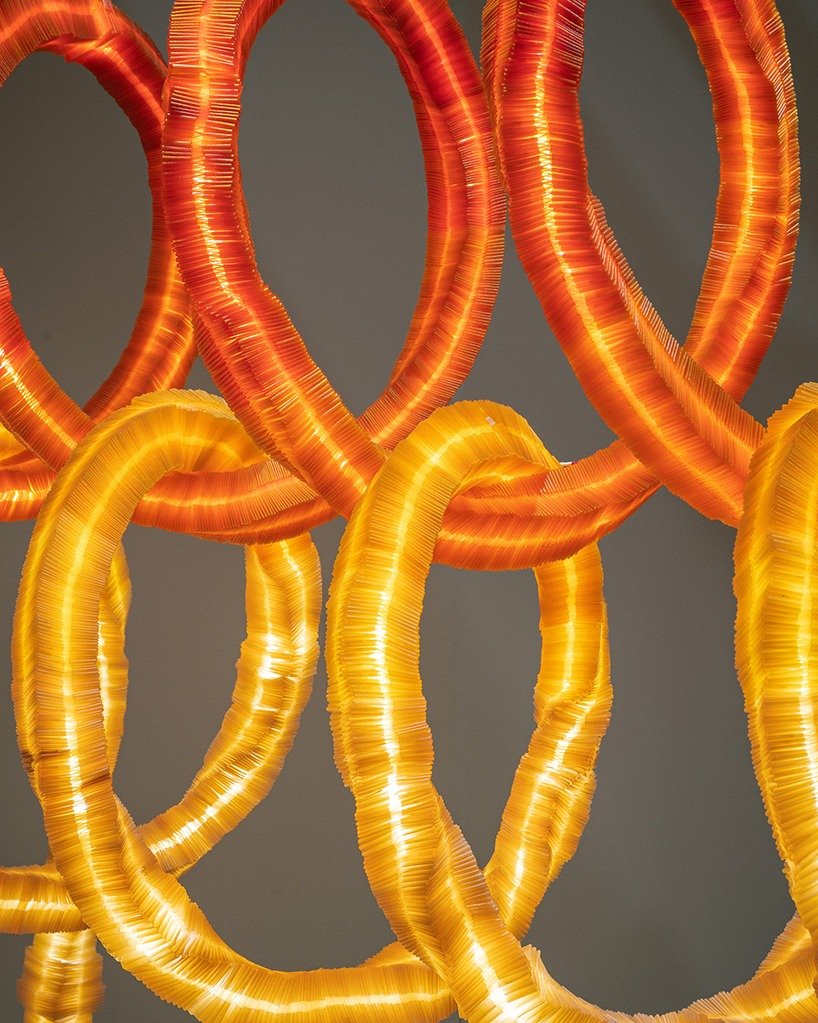
Slow2, created by Su Yang Choi, transforms seaweed-derived agar into a luminous architectural skin.
Giuliana Bruno has written about surfaces as active meeting places between material, image and touch. Slow2 makes that idea unusually literal. Its skin is not merely something to look at; it decides how much light escapes, where colour gathers and when the armature becomes visible. The agar sheet withholds sharp information. That withholding is productive. Unlike the acrylic bag, it does not invite the fantasy that a viewer can grasp the whole object in one clean look.
The softness of the light should not be confused with settled technical evidence. Research on agar films describes useful transparency and film-forming capacity, but also recurrent problems with brittleness, moisture sensitivity and barrier performance. Those findings concern tested formulations for other applications, not Slow2 itself. Choi's exact recipe, thickness, exposure conditions and intended lifespan would need project-specific documentation before anyone could make confident claims about durability or controlled biodegradation.
Nor is the installation simply “biodegradable” as a whole. Agar may form its most visually distinctive layer, but steel, LEDs, insulation and adhesive remain part of the work; how the membrane is attached matters. So does whether it can be peeled away without contamination, replaced after damage, or separated when the lighting components reach the end of their useful life. The glow brings the materials together beautifully; disposal will ask them to part company.
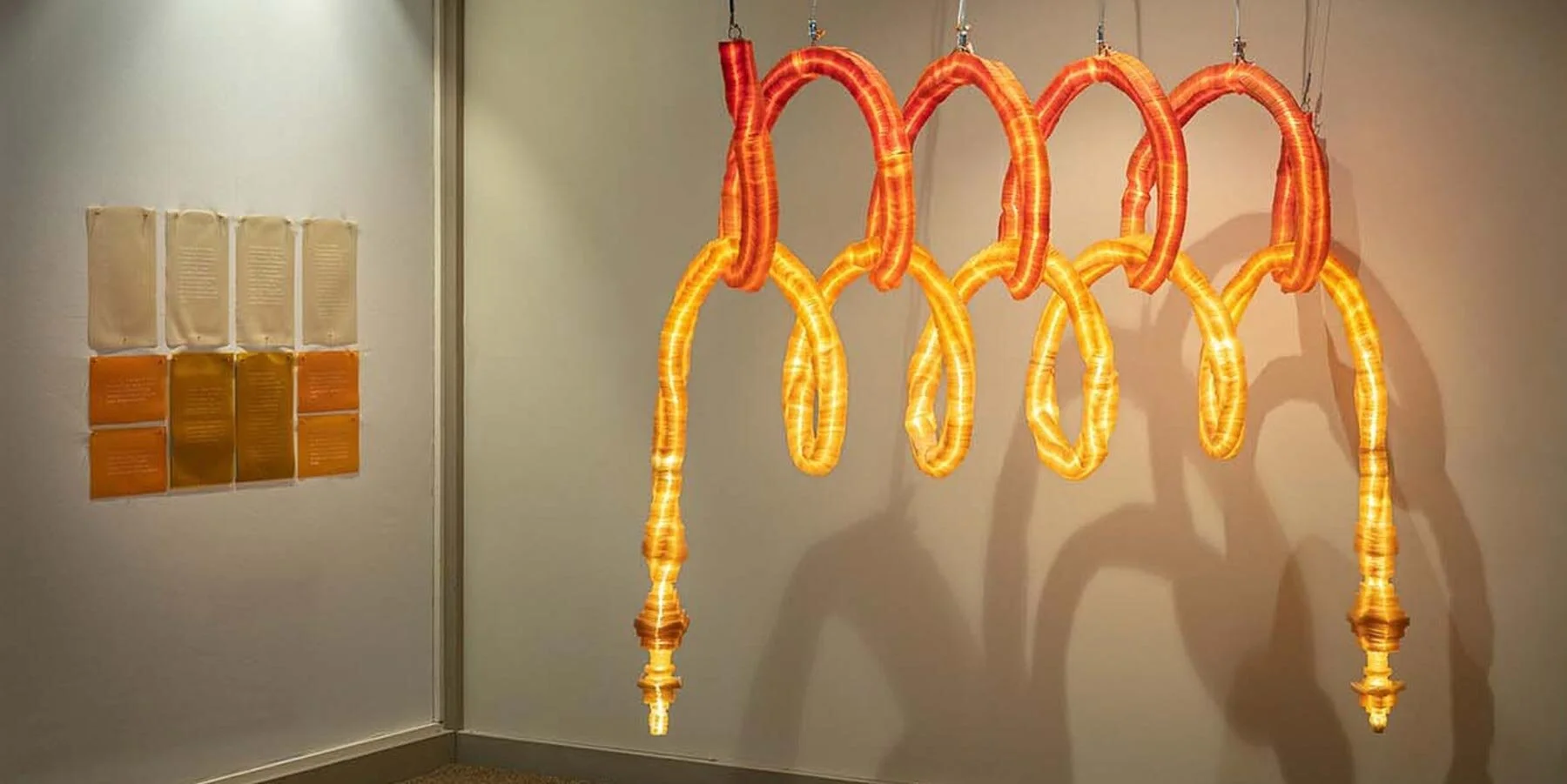
Seaweed light brings structural memory together with biodegradable, atmospheric material futures by Choi
Placed side by side, the works reveal two very different uses of visual access. Bentel's acrylic behaves like a display case. It sharpens edges and lets components keep their names: screw, wire, socket, control. Slow2 works as a diffuser. It blurs those distinctions, letting pigment, thickness and illumination merge into a single atmosphere. One says, “look inside”. The other asks the eye to stay with the surface a little longer.
Time will alter both readings. Acrylic gathers fingerprints and scratches; electronic formats and batteries age even when the shell remains intact. Agar is valued partly for its capacity to change and eventually break down, yet humidity, heat and handling may make that change inconvenient long before it becomes environmentally meaningful. These are not objections to the works. They are the ordinary questions that arrive after the exhibition photograph, when an object has to be stored, cleaned, repaired or dismantled.

A Wearable Sound System: Fashion as Public Infrastructure by NiK Bentel Studio offers a transformative approach to how we experience sound in daily life.
Steven Jackson's writing on repair is helpful precisely because it begins from that later moment. Objects disclose themselves differently when something fails. A loose connection may make the bag's internal logic clearer than transparency ever did. A torn or shrunken membrane may reveal how Slow2 was tensioned around its frame. Maintenance is not glamorous, but it tests whether an object's apparent openness extends to the people asked to care for it.
The clearest detail, in the end, is also the smallest: a metal fastener holding coloured acrylic under tension; a seam in an agar sheet brightening as the LED behind it turns on. Neither tells the whole truth about the object. Both give the eye somewhere honest to begin. Transparency is valuable less because it eliminates mystery than because it shows where to ask the next question.
Bibliography
Art & Materials Lab (2026a) 'Slow2 - Su Yang Choi'. Available at: https://www.artandmaterialslab.com/materials/slow2-suyang-choi (Accessed: 20 September 2026).
Art & Materials Lab (2026b) 'The Speaker and Mixer Bag - Nik Bentel Studio'. Available at: https://www.artandmaterialslab.com/art/thespeaker-and-mixerbag (Accessed: 17 September 2026).
Bruno, G. (2014) Surface: Matters of Aesthetics, Materiality, and Media. Chicago: University of Chicago Press.
designboom (2026) 'Seaweed-based biodegradable material shapes two interlocking tubular light installations', 9 May. Available at: https://www.designboom.com/design/seaweed-based-biodegradable-material-two-interlocking-tubular-light-installations-slow2/ (Accessed: 17 September 2025).
Jackson, S.J. (2014) 'Rethinking repair', in Gillespie, T., Boczkowski, P.J. and Foot, K.A. (eds) Media Technologies: Essays on Communication, Materiality, and Society. Cambridge, MA: MIT Press, pp. 221–240. Available at: https://doi.org/10.7551/mitpress/9042.003.0015 (Accessed: 7 September 2026).
Nik Bentel Studio (2026) 'The Tati Fête Bag: Speaker + Mixer'. Available at: https://nikbentel.com/projects/234my5zh (Accessed: 7 September 2026).
Roy, S., Chawla, R., Santhosh, R., Thakur, R., Sarkar, P. and Zhang, W. (2023) 'Agar-based edible films and food packaging application: A comprehensive review', Trends in Food Science & Technology, 141, 104198. Available at: https://doi.org/10.1016/j.tifs.2023.104198 (Accessed: 12 September 2026).
Responsible Editor
Mark Jackson