The Weight of Traces: On the Politics of Repair in Weaving and Mending
On the Politics of Repair in Weaving and Mending
Hundreds of steel scissors hang point-downward from the ceiling; their mass concentrated over a low black table. Black thread drops from the open blades, accumulating in dense, irregular clusters on the surface below. From a distance, this structure appears as a solid canopy of metal and fibre, a dark volume pressing down on the floor and dictating the room's vertical tension. At close range, the individual threads isolate, pulling taut under the gravitational drag of the iron shears, while severed ends pool unevenly on the wood, exposing the frayed tips of the cut cotton. I argue that traces of rupture and acts of connection do not occur in sequence; they are produced through one another, operating not as the erasure of damage but as the redistribution of material burdens, labour, and control.
The Deferral of Closure
In Beili Liu’s The Mending Project, iron scissors suspend in the air while the artist sits below, continuously cutting and stitching black fabric. The thread binds the cloth, dragging the raw edges together through repetitive needlework, while the shears overhead threaten to sever the connection at any moment. The installation engulfs the room's upper volume, forcing a horizontal plane of sharp metal to bear down on the site of labour, intercepting the ambient light and casting fragmented, jagged shadows across the work surface. The viewer’s body is forced into an immediate, physical hesitation; stepping into the room requires an acute awareness of the heavy, pointed canopy overhead, causing the viewer to alter their posture, lower their shoulders, and maintain a defensive stance beneath the suspended steel.
I invoke it here to turn a formal problem into a theoretical tool: as Briony Fer asserts regarding seriality, the logic of repetition does not lead to completion but rather to continuous extension, where the single line multiplies into an infinite field of structural tension. Liu’s endless stitching and severing demonstrates that mending here functions as duration rather than closure. The thread does not finish the object; it extends the act of maintenance indefinitely. The site of repair becomes a stage of perpetual exposure, keeping the fracture materially present through the constant, suspended application of thread.
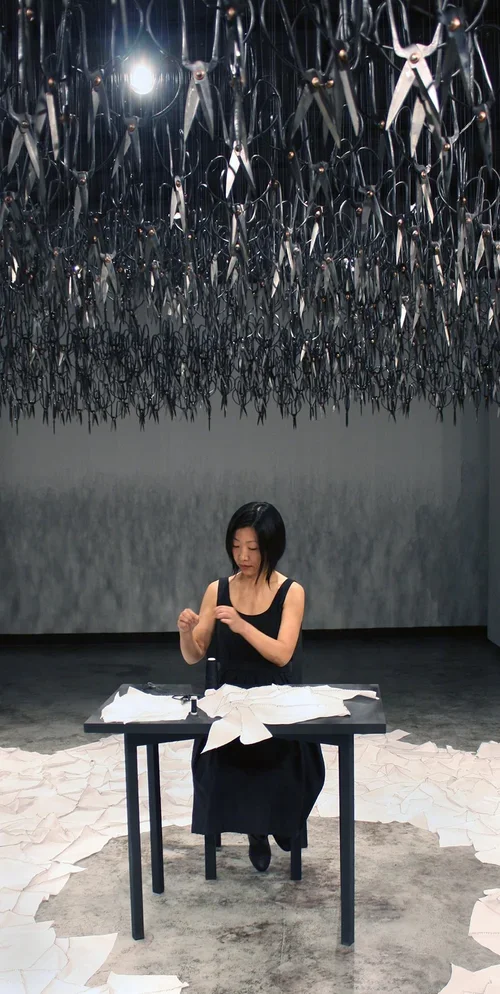
The Mending Project by Beili Liu
Coding the Surface
Husnyi Huang’s Darning ME presses this structural tension directly onto the boundaries of the self, packing dense, foreign thread into punctured holes across garments that map the body's vulnerabilities. The act of darning forcefully binds the frayed edges of the textile, pulling the surrounding weave inward to create a raised, tightened nodule of thread that sits rigidly against the softer host fabric. These patches compress the visual plane, catching the light unevenly and drawing sharp attention to the site of the former void rather than smoothing it into the background. They disrupt the flat drape of the cloth, creating localised zones of friction that interrupt the garment's smooth fall. Encountering these dense interventions necessitates a physical convergence; the viewer must step closer, straining the eyes to distinguish the thick, raised thread from the original weave, recalibrating their distance to scrutinise the micro-structure of the mend. The darned patch does not cancel the rupture; it gives the damage a new contour. The act of connection simultaneously acts as a highly visible coding of the surface, establishing mending as an act of inscription that forces the damage back into the visible register. Repair, in this instance, does not absorb the flaw but weaponises it, asserting that the patched surface is a reorganisation of the garment’s visual economy.
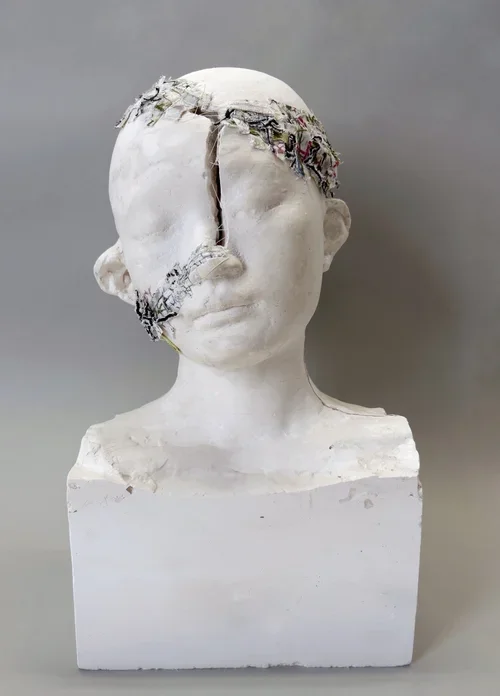
Darning ME by Hsunyi Huang
The Friction of Time
The argument hardens structurally and materially in Shinhye You’s The Living Stones, where rigid mineral fractures are bound by pliable, synthetic thread. The thread abrades against the sharp, jagged edges of the split stone, filling the empty void of the crack while failing entirely to fuse the geological mass back into a singular entity. The work anchors immense weight to the floor, halting spatial movement as the bright lines of thread rigidly bisect the heavy blocks, disrupting the smooth, expected continuity of the gallery architecture. The stone's spatial density demands a severe narrowing of vision, pulling the viewer’s gaze downward, compressing their posture, and slowing their pace as they are forced to navigate cautiously around the inert, heavy obstacles.
I invoke it here to fill a conceptual gap: Alex Potts argues that the tactile insistence of certain three-dimensional works forces a confrontation with the raw material's presence rather than visual illusion, grounding the viewer's experience in the object's literal, physical weight. The thread does not unify the stone; it acts as a mechanical wedge, an interloper between two severed faces of rock. Time and friction lodge within the crack to guarantee that the fracture is carried and supported. The stone accepts the thread not as a cure, but as a scaffold, proving that repair is often a mechanism for holding broken parts in forced proximity rather than returning them to an original wholeness.
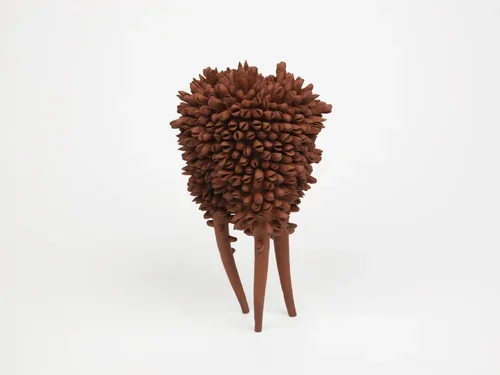
The Living Stones by Shinhye You
The Discipline of Maintenance
Megumi Ohata’s Haori forces the tension of repair into the architecture of a worn garment, where tight stitches constrict the fatigued fibres of the silk. The thread pulls sharply against the grain, reinforcing the weakened areas through dense, repetitive stitching that stiffens the fabric, seizing the loose, exhausted fibres and locking them into a rigid, superimposed grid. The mended garment hangs structurally inflexible, imposing a historic geometry of maintenance that maps the exact distribution of wear, friction, and bodily tear across the cloth, cutting off the line of sight through its opaque, layered accumulation. Confronting the suspended garment forces an acute awareness of the absent body, demanding that the viewer negotiate the sheer scale of the hidden labour required to hold the fragile structure together, and to stand squarely before the physical evidence of material exhaustion.
Mending the haori shifts repair from an act of private survival to a strict system of public discipline and social order. Surface continuity is preserved through exhaustive, highly structured labour, which manages the tear and disciplines the fabric to remain wearable. Repair is exposed not as an act of care, but as an exertion of control over the material's inevitable decline, dictating exactly who is permitted to tear the cloth and who is fundamentally obligated to mend it.
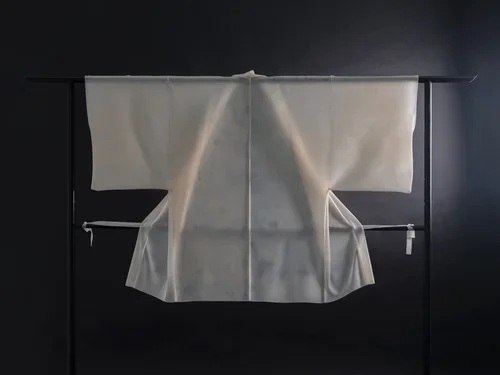
Haori by Megumi Ohata
The politics of repair reside strictly in the spatial and material negotiations required to maintain a boundary under duress. Each stitch, each drawn thread, each packed hole serves as an index of sheer force applied against a breaking point. Mending reorganises the social and physical weight of the damage, redistributing the pressure across the surrounding fibres and onto the bodies tasked with their silent upkeep. The illusion of a continuous surface is merely a result of managed tension, an imposed, historical order that refuses to let the material collapse, yet never allows it to revert to a state of absolute integrity. Fracture is never fully sealed, nor is the act of connection ever entirely finished; the tension is merely held in place by an uneven knot at the edge of the cloth.
Bibliography
Fer, B., 2004. The Infinite Line: Remaking Art After Modernism. New Haven: Yale University Press.
Potts, A., 2004. 'Tactility: The Interrogation of Medium in Art of the 1960s', Art History, 27(2), pp. 282-304.
Huang, H., 2021. Darning ME., Art and Materials Lab. Available at: https://www.artandmaterialslab.com/art/darning-me (Accessed: 3 April 2026).
Liu, B., 2011. The Mending Project, Art and Materials Lab. Available at: https://www.artandmaterialslab.com/art/the-mending-project-beili-liu (Accessed: 3 April 2026).
Ohata, M., 2020. Haori, Art and Materials Lab. Available at: https://www.artandmaterialslab.com/art/haori-megumiohata (Accessed: 3 April 2026).
You, S., 2019. The Living Stones, Art and Materials Lab. Available at: https://www.artandmaterialslab.com/art/thelivingstones-shinhyeyou (Accessed: 3 April 2026).
Responsible Editor
Ethan Liu