Fossils of the Future: When Materials Begin to Leave Humanity’s Last Words
From a distance, the objects sit low under gravity; light stops along their edges, and shadows spread outward across the floor. Air gathers between wood, brass, image, clay, cloth, and suspended iron. Every joint marks a direction of force, and every surface carries the evidence of pressure, cutting, firing, rendering, or repair. Up close, the grain of wood resembles a sedimentary layer; the edge of brass returns a narrow line of light; the ceramic surface holds the density of fired particles; black stitches pull white cloth into ridges and valleys.
This mode of looking can be called confrontation: the material does not withdraw behind form but occupies the work's argumentative centre. This is not about passive preservation or active forgetting, but about how temporal residue and human intervention mutually generate one another. I argue that these five works do not simply show how materials are used in art; they show how materials begin to compose humanity’s last words before history has even finished happening.
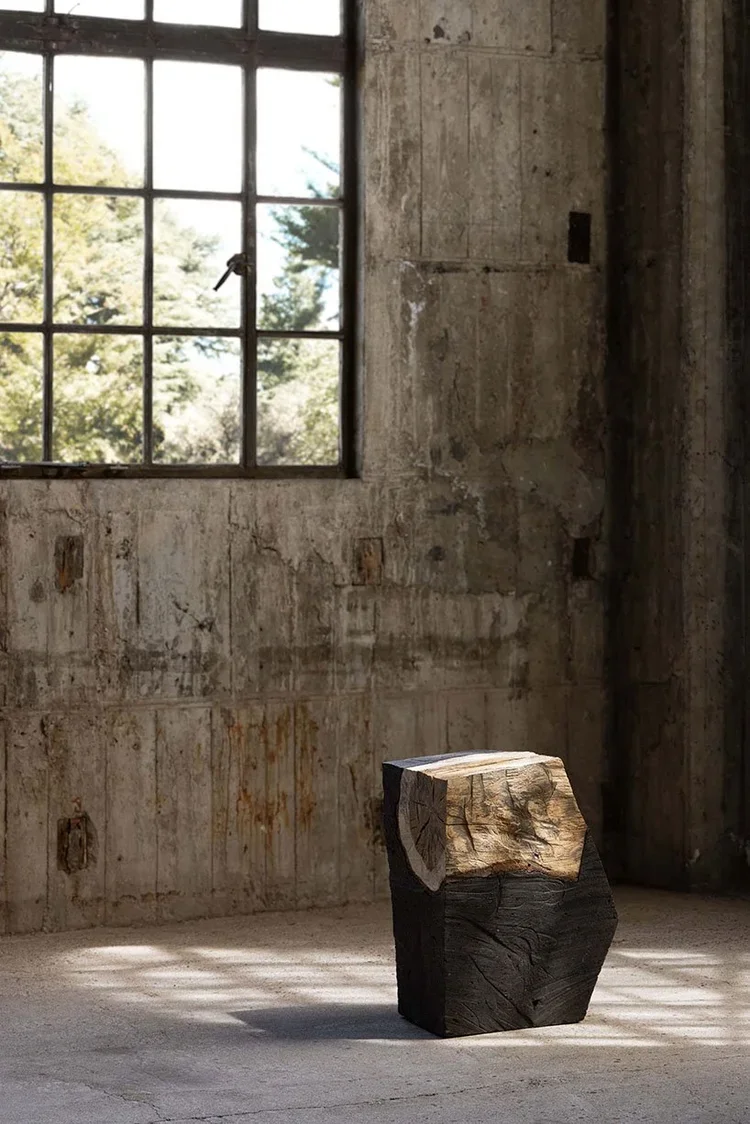
In So Koizumi Design’s Fossilised Future, furniture is not allowed to remain furniture. Art and Materials Lab describes the project as a raw wooden furniture collection that imagines the fossilised forms of contemporary resources, using wood from diseased forests and local soil-like materials; it was presented during Milan Design Week 2024 at Alcova Milano. The method is not preservation in the sentimental sense. It is a deliberate act of premature burial. The wood appears less like a domestic surface than a compressed record of ecological damage, extraction, handling, and design intervention. Its material condition is fossilised before geological time has had the chance to do the work.
The form stages a future excavation: a table or chair seems to have passed through use, collapse, disappearance, and rediscovery all at once. The viewer’s body is forced downward, not emotionally but physically, as if one must lean toward a fragment whose function has become uncertain. In this work, time is not something that naturally settles over matter; it is inserted by human design. The object becomes a rehearsal of extinction and survival, a reminder that what we call a product may already be an artefact in training.
Fossilised Future & SEVEN by So Koizumi Design
If Fossilised Future gives residue a body, SEVEN gives instability a sound. The same Art and Materials Lab article identifies SEVEN as a brass sculptural wind chime based on tensegrity principles, exhibited in the historic underground space of Villa Bagatti Valsecchi; it is made entirely from brass, produces harmonious tones when moved by wind, and required the technical skill of artisans from seven factories in Takaoka City. Brass here is not ornamental. It is taut, relational, held in a system where each component depends on the tension of another. The work stages social structure not as a diagram but as a physical condition: a light movement can activate the entire arrangement.
It does not need a catastrophe to reveal fragility; a breath of air is enough. The viewer’s body responds through the neck, ear, and balance. One waits for sound and, in waiting, becomes aware that equilibrium is not the same as stability. I cite Jane Bennett as a theoretical instrument: in Vibrant Matter, Bennett argues for the active participation of nonhuman forces in events and for a “vital materiality” distributed across human and nonhuman bodies. In SEVEN, wind, brass, craft, gravity, and acoustic vibration together produce the work’s political intelligence. The material is not merely carrying a metaphor of society; it performs society as a fragile assemblage of forces.
Rocks and Light by Studio Brasch
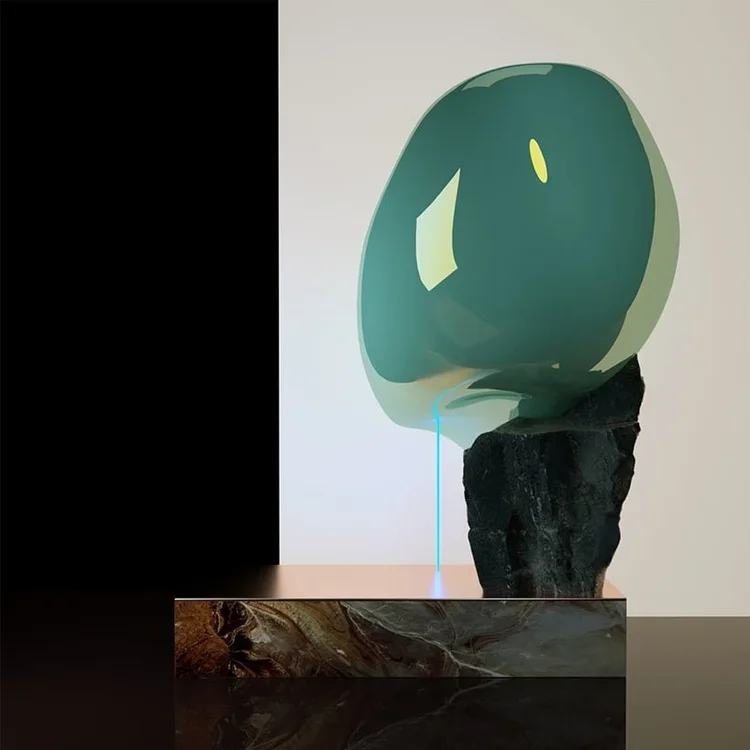
Studio Brasch’s Rocks and Light requires a more precise kind of attention. It is not an installation of physical stones in a gallery. Art and Materials Lab describes Anders Brasch-Willumsen’s collection as an exploration of photorealism in 3D-rendered imagery, using stone to transform the perception of the image and to create a realm oscillating between prehistoric and futuristic, tangible and virtual. The method is therefore not carving but rendering; not geological removal but digital staging. Stone, one of the oldest material signs available to human perception, is placed inside an image system associated with simulation, surface, and technical light. The form disrupts the stone’s expected behaviour. Stone should be heavy, slow, resistant, and difficult to move.
Here, it is carried by pixels, crossed by artificial illumination, and made to hover between mass and appearance. The viewer cannot test its weight by touch; the body is held at the threshold of the screen, where the eye performs the labour usually assigned to the hand. I cite Jussi Parikka to expand the historical framework: A Geology of Media insists that media theory must be extended toward material composition, mineral histories, and the deep temporality of the earth. The University of Minnesota Press describes the book as an ecological take on technology, and its discussion of media materiality links digital time to geological time. Through this lens, Rocks and Light asks whether future ruins will be stones or files that preserve the cold illusion of stones. The digital image is not immaterial; it is another geological event wearing the surface of light.
The Living Stones by Shinhye You
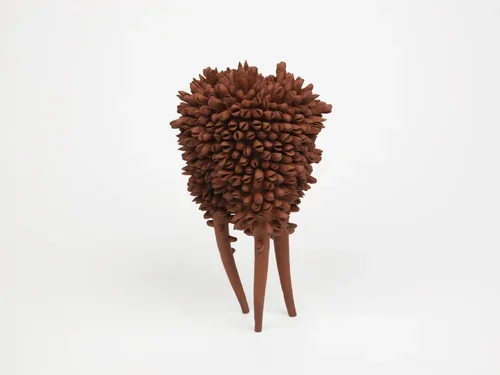
Shinhye You’s The Living Stones moves from geological illusion to biological afterlife. Art and Materials Lab states that your ceramic practice combines magical realism with self-written narratives; each ceramic piece embodies a story, and your making process involves assembling tiny fragments of raw clay. In her imagined universe, individuals leave behind crystalline remnants after death, and these residues continue to grow in the world of the living as memorials for the departed. The method is one of assembly, firing, and narrative transformation. Clay is not used to represent the body from the outside; it is made to behave as though the body has changed states.
The form occupies a zone between organ and mineral. Protrusions, cavities, clustered fragments, and crystalline suggestions lead the viewer to read the sculpture as a structure that was once alive, or as a residue that still has biological ambition. The viewer’s body must circle, pause, and infer. One does not simply see a figure; one reconstructs a life from attachments and surfaces. Here, temporal residue is not inert. Once shaped by ceramic craft and fictional cosmology, death becomes a material that continues to grow. Human intervention does not defeat decay; it invents a form in which decay can speak.
The Mending Project by Beili Liu
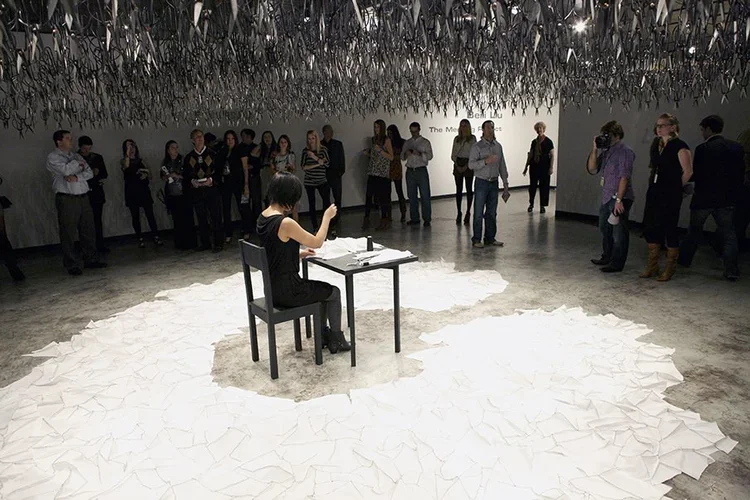
Beili Liu’s The Mending Project may be the sharpest final note because it does not let repair appear innocent. Art and Materials Lab records that the work consists of 1,500 pairs of Chinese iron scissors suspended from the ceiling, pointing downward and forming a menacing dark cloud; beneath them, a woman continuously mends pieces of white cloth cut by viewers near the gallery entrance. The sewn fabric, filled with ridges and valleys of black stitches, lies on the floor and grows throughout the performance. The materials divide the space into threat and labour. Iron cuts. Cloth receives. The thread pierces and pulls back together. The form engulfs the viewer from above, then redirects attention to the floor. The first bodily response is cranial: one registers the blades’ downward direction.
The second response is manual: one imagines the action of cutting, handing over, piercing, knotting, tightening. This is not a scene in which tenderness cancels violence. It is a scene in which violence and repair are made structurally inseparable. The work returns the central tension with almost unbearable clarity: human intervention produces the wound, and human intervention produces the stitch; temporal residue is not what remains after action, but what action continually manufactures. Civilisation’s final footnote may not be a monument. It may be a piece of cloth enlarged by damage, held together by lines that cannot undo the cut.
Across these works, material becomes a language of delayed evidence. Diseased wood rehearses its own archaeology. Brass allows social balance to be heard as a metallic event. Rendered stone asks whether virtuality is only another form of geology. Fired clay imagines death as continued material growth. Iron scissors and black thread expose repair as both inadequate and necessary. The future archaeologist would not need our explanations first. They could read our era through weight, tension, surface, fracture, reflection, and seam. Artists do not make materials beautiful in these works. They accelerate their becoming-evidence, so that we might encounter our own remains while we are still able to alter what we leave behind. What persists, finally, is not an idea floating free of matter, but a pressure held in matter: a faint line of light along the brass edge, just after the wind has moved it.
Bibliography
Art and Materials Lab (2024a) ‘Fossilised Future & SEVEN - So Koizumi Design’, Art and Materials Lab, 11 October. Available at: Art and Materials Lab. Accessed: 1 May 2026.
Art and Materials Lab (2024b) ‘The Mending Project - Beili Liu’, Art and Materials Lab, 22 May. Available at: Art and Materials Lab. Accessed: 7 May 2026.
Art and Materials Lab (2023a) ‘Rocks and Light - Studio Brasch’, Art and Materials Lab, 12 October. Available at: Art and Materials Lab. Accessed: 5 May 2026.
Art and Materials Lab (2023b) ‘The Living Stones - Shinhye You’, Art and Materials Lab, 28 September. Available at: Art and Materials Lab. Accessed: 7 May 2026.
Bennett, J. (2010) Vibrant Matter: A Political Ecology of Things. Durham: Duke University Press. Available at: Duke University Press. Accessed: 1 May 2026.
Parikka, J. (2015) A Geology of Media. Minneapolis: University of Minnesota Press. Available at: University of Minnesota Press. Accessed: 1 May 2026.
Responsible Editor
Isabel Pavone