The Living Habitat: From Static Construction to Organic Evolution
From a distance, the structure appears as a silent, monolithic outcropping of packed earth, a geological formation that seems to have withstood centuries of environmental wear. Yet, upon closer examination, a vibrant and frantic life emerges: tiny green shoots break through the dull, desiccated surface. At the same time, an unseen network of roots begins to weave a living tapestry within the soil's layered composition. This moment of observation—shifting from the perceived stillness of the mass to the energetic pulse of the sprout—illuminates a state of structural germination. Here, the line between the architectural and the botanical blurs, transforming into a porous zone of exchange.
I propose a design philosophy that moves away from the sterile isolation of the 20th-century white cube and embraces a site-specific, biological urgency. I refer to this shift as the Metabolic Turn, in which the interior space is no longer just a container for life but becomes a life-form in its own right. I contend that the future of our habitats lies in seamlessly integrating technology and biology, allowing the material itself to adopt an attitude—an ethical stance against the static permanence characteristic of traditional construction.
The project titled To Grow a Building (Soil & Seed 3D Printing) marks a significant departure from the dead matter that has defined modern construction. The material—a blend of local soil, organic compost, and dormant seeds—is extruded through a 3D printer, resulting in a form that functions as both a sculptural object and a living ecosystem. As the structure takes shape, life erupts within the soil; the seeds germinate in the damp interior of the wall, with roots seeking out the structural voids, creating a natural reinforcement beneath the surface. The wall no longer occupies space; it engages with it through a slow, rhythmic expansion of biomass that enhances the room's air quality and thermal mass.
For onlookers, this experience unfolds as a multisensory encounter: the scent of moist earth and the cooling sensation of transpiration replace the sterile, chemical odour of industrial drywall. Viewers are drawn into the compelling growth process even as they are urged to retreat from the fragile reality of the soil.
I reference this to frame the concept of the Metabolic Interior, positioning architecture not as a finished product but as a dynamic, ongoing process. This approach compels a shift in the body’s relationship with the space, transforming the inhabitant from a passive consumer into an active gardener of their own shelter. Ultimately, this discussion circles back to its core tension: the soil represents both the hand of the machine and the breath of the seed, illustrating that the wall is not merely a barrier but a vital lung.

To Grow a Building by Elisheva Gillis, Gitit Linker, Danny Freedman, Noa Zermati, Adi Segal, Rebeca Partook, Or Naim, and Nof Nathansohn
The soil wall acts as the fundamental structure of this new habitat, while the Lapso – Celium (Bacterial Cellulose) serves as its living skin. This innovative material is created through a controlled fermentation process where bacteria spin cellulose nanofibers into a translucent, leather-like membrane. This unique material bathes the space in a soft, diffused light, boasting a surface characterised by its distinctive, fingerprint-like pattern stemming from biological growth, which remains visible even after harvesting. Whether fashioned into acoustic panels or translucent lighting fixtures, the cellulose envelops the atmosphere, effectively dampening sound with its fibrous density while softening the room's hard edges. Those who encounter it are drawn to its surface, compelled to touch a texture that strikingly resembles human skin yet is entirely plant-based.
I mention this to introduce the term ephemeralization. This idea, famously explored by Buckminster Fuller, sharpens our understanding that as our materials evolve to feel more "alive," they also become more valuable and vulnerable to decay, prompting us to confront the impermanence of our possessions. I highlight this to address a gap in current discussions: sustainability transcends mere recycling; it’s about the transparency of the growth process itself. The cellulose is a manufactured product, yet it still holds the grown essence of its bacterial origin, bridging the divide between the industrial lab and nature's floor. This organic veil surrounds the viewer's body, creating a sensation of being within a living organ rather than simply being in a room.

Lapso – Celium by Polybion™ with Natural Urbano
Organicism in living spaces extends beyond the high-tech lab; it also finds its place in the returned materials of the Mok-04, Rice Straw & Jige project. By repurposing rice straw alongside the traditional Korean Jige carrier structure, this initiative transforms agricultural waste into furniture that serves as a tactile anchor amidst our increasingly digital surroundings. The straw is intricately woven and compressed into a dense, fibrous mass, instilling a sense of historical connection within contemporary interiors. Unlike the translucent cellulose that floats and glows, this material makes a grounded statement with its heavy, earth-scented presence, commanding physical respect. The viewer must adjust to the "rough" authenticity of the straw, creating a stark sensory contrast to the smooth surfaces of glass and aluminium.
I reference this work to address gaps in existing bio-design discussions, which often neglect the significance of material memory and indigenous knowledge in our shift towards sustainable living. Additionally, it lays the groundwork for the concept of tactile interrogation, as discussed by Alex Potts, where the medium itself becomes the focal point of the viewer's physical exploration. The piece acts as a tangible bridge, merging the ancient practice of weaving agricultural byproducts with a contemporary act of ecological resistance. By situating a "rough," earth-scented stool within a sleek, high-tech glass apartment, the designer disrupts conventional perspectives, compelling the viewer to look down and acknowledge the very ground from which all materials originate. This brings us full circle to the knot: the furniture serves as both an ancient carrier and a modern seat, generating a sense of time-depth within the immediate present.
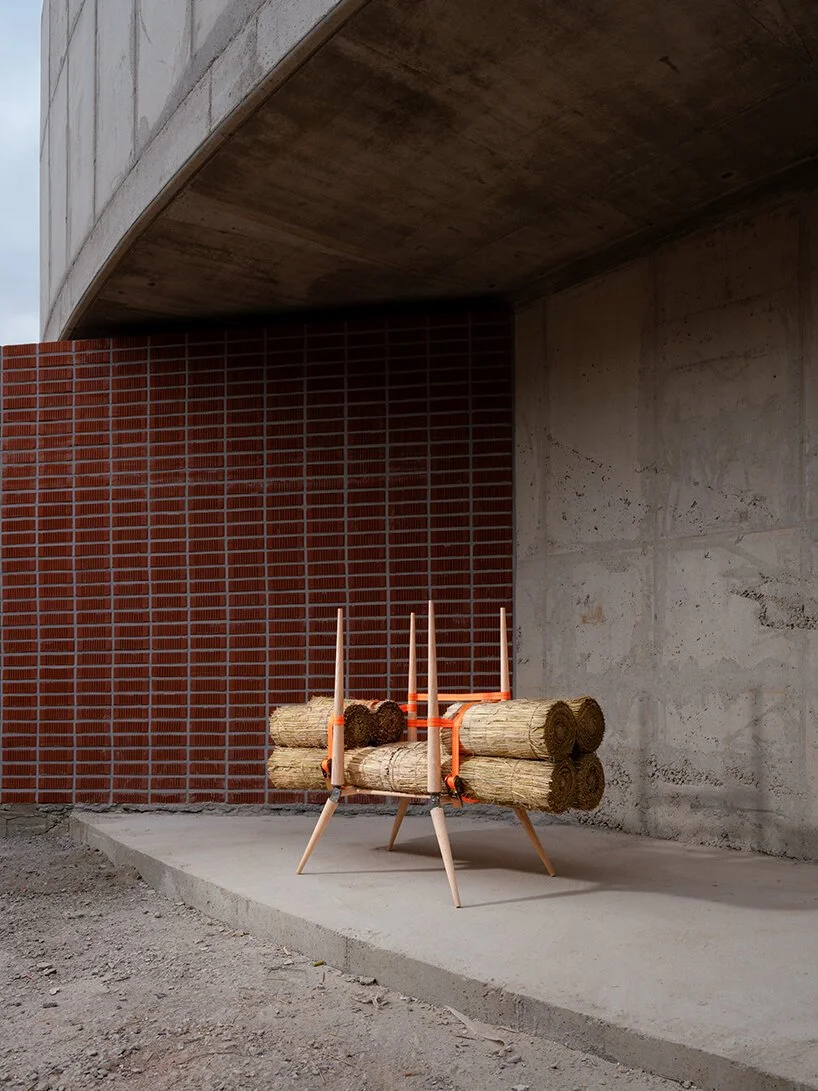
Mok-04, Rice Straw & Jige by Sukchulmok Studio
To ensure that a living habitat doesn't become merely a romanticised vision of nature, it demands the solid connectivity offered by the &omni chair. Made from high-polished, medical-grade stainless steel, its design features a series of clinical, geometric lines that starkly contrast the organic softness of straw and soil. The steel interrupts the visual landscape, mirroring the green shoots on the walls and the translucent cellulose lamps with its reflective surface. This material serves as the nervous system of the space—sleek, cold, and infinitely connective. Viewers experience a sharp sensory transition: the warmth of rice straw gives way to the unyielding precision of metal.
I highlight the term connectivity as a key concept, allowing us to perceive the chair not as a static object but as a synapse that facilitates communication between the grown and the manufactured. This also sheds light on a crucial point that existing discussions often overlook: for a building to be truly living, it must incorporate elements of the clinical to establish both structural and psychological boundaries. The &omni chair provides the essential click that enables the metabolic room to function effectively as a modern home, ensuring that the living habitat remains practical and beautiful. It creates the necessary tension that prevents organic materials from dissolving into ambiguity. The body finds comfort in the ergonomic curve of the steel, discovering a point of stability amidst the ongoing growth of the surrounding environment.

&omni chair by Boyeon Kim and Jaehan Choi
The living habitat is not a choice between the garden and the machine, but a seamless integration in which the chair breathes and the wall pulses. We have shifted from viewing materials as information—mere data points in a building's spec sheet—to understanding them as evidence of a new ethical attitude towards the planet. By elevating the viewer's feelings into reasoned evidence of metabolic design, we recognise that the environment is no longer something we merely build in, but something we grow with. The future of design lies at this blurred boundary, where the hand that touches the cold stainless steel also senses the vibrating vitality of the root.
This is the ultimate goal of the research, one of my aims, in collaboration with the Art & Materials Lab, where the alchemy of substance meets the rigour of design. Ultimately, the habitat settles into a final, tangible detail: a single green line of a sprout, emerging from the dark soil of the partition, leaning quietly towards the artificial light of a cellulose lamp, its weight supported by a frame of polished steel. It is here, at the junction of the line and the leaf, that the living habitat finds its pulse.
Bibliography
Asawa, R. and Nathan, H. (1976). The Arts and Community Oral History Project, Ruth Asawa: Art, Competence and Citywide Cooperation for San Francisco. Berkeley: University of California Press.
Benglis, L. (1970) ‘I’m mocking nature with plastics’, Artforum International, 1(1).
Boyeon Kim & Jaehan Choi (2024) ‘&omni chair’, Art and Materials Lab. Available at: https://www.artandmaterialslab.com/spatial/omni-chair-boyeon-kim-and-jaehan-choi (Accessed: 1 March 2026).
Chalaby, C. (2020) ‘The Immateriality of Materiality: Ruth Asawa’s Looped Wire Sculpture’, Art History, 44(2).
Fuller, B. (1938) Nine Chains to the Moon. New York: Lippincott.
Or Naim & Elisheva & Team (n.d.) ‘To Grow a Building’, Art and Materials Lab. Available at: https://www.artandmaterialslab.com/spatial/togrowabuilding-ornaimelisheva-andteam (Accessed: 1 March 2026).
Polybion (n.d.) ‘Lapso Celium’, Art and Materials Lab. Available at: https://www.artandmaterialslab.com/materials/lapsocelium-polybion (Accessed: 1 March 2026).
Potts, A. (2004) ‘Tactility: The Interrogation of Medium in Art of the 1960s’, Art History, 27(2), pp. 282-304.
Reynolds, A. (2019) ‘Lessons in Transparency’, in Ryan, Z. (ed.) In A Cloud, In A Wall, In A Chair: Six Modernists in Mexico at Mid-Century. Chicago: Art Institute of Chicago.
Serra, R. (1967). Verb List. New York: Museum of Modern Art.
Sukchulmok (2023) ‘Mok-04, Rice Straw & Jige’, Art and Materials Lab. Available at: https://www.artandmaterialslab.com/spatial/mok04-ricestrawjige (Accessed: 1 March 2026).
Responsible Editor
Isabel Pavone