The Right to Rot: How Biomaterials Disrupt the Myth of Eternal Art
In the far corner of a gallery, under a bell jar, a work is quietly changing its mind. Yesterday it read as a crisp, pale object—almost industrial in its cleanliness. Today, a soft grey bloom creeps along its edge. Mycelium doesn’t “age” the way bronze does; it acts. It measures humidity, detects drafts, and responds to the salt in human breath. Nearby, a thin membrane catches the light like skin: bacterial cellulose, grown rather than fabricated, holding its own layered history—every ripple a trace of fermentation, every density shift a record of time spent alive. A little further on, an algae-based bioplastic form sits close to a radiator and subtly slumps, as if refusing the museum’s oldest demand: stay still, stay forever.
The room tries to hold the line—climate control hums. Labels translate behaviour into reassurance. Conservators linger at the edge of the story, ready to intervene if the piece “fails.” But biomaterials turn the gallery into a lab without granting it lab authority: the institution can monitor, yet never fully command. In that gap—between control and consent—the work begins to speak.
We’ve been trained to treat permanence as a virtue. The museum—white walls, controlled climate, dustless air—operates like a life-support system for objects. It lifts artworks out of the messy circulation of the world and seals them inside a fantasy of continuity. But biomaterials are uncooperative citizens of that fantasy. Mycelium, bacterial cellulose, algae bioplastics: these aren’t inert substances waiting to be shaped. They carry metabolism, moisture, and microbial alliances. They behave less like “materials” and more like collaborators—nonhuman subjects that negotiate, react, sometimes even resist. To work with them is to accept a basic shift in authorship: you don’t fully command the outcome; you set conditions and witness what follows.
If that sounds romantic, it isn’t. Collaboration with living matter is not a dreamy metaphor; it’s a practical friction. It smells. It stains. It contaminates. It demands time and care, and then—infuriatingly—it still refuses to be consistent. Biomaterials make visible what industrial design has spent generations hiding: that matter has agency, and that agency has costs. In doing so, they also expose how much of “good design” is simply the triumph of standardisation over the world’s natural tendency to diverge.
This is where their politics begin—not with a green label, but with a refusal. Biomaterials insist on what we might call the right to rot. They drag decay out of the category of failure and return it to the realm of legitimacy. And once you accept that a work may be designed to disappear, the museum’s logic starts to wobble: if an artwork is destined to grow, soften, mould, dry, crack, or dissolve, how do we measure value? What happens to the idea of “collecting” when the object is less possession and more event?
One answer is uncomfortable: the myth of eternal art is not just an aesthetic preference. It is an industrial dream—an extension of a civilisation that believes it can freeze the world into assets, preserve prestige indefinitely, and postpone consequences with better storage and stronger packaging. Biomaterials puncture that dream, not with slogans, but with behaviour. They leak time back into the room.
Take bacterial cellulose in the Lapso–Celium series by Polybion and Natural Urbano: lighting objects that foreground growth rather than manufacture, where every surface bears the unrepeatable signature of fermentation—creases, gradients, thickness changes that no mould can truly standardise. The material doesn’t merely wear; it remembers. It turns the gallery into a living set of conditions, and the artwork into a negotiation with air, light, moisture—an ecology rather than a product.
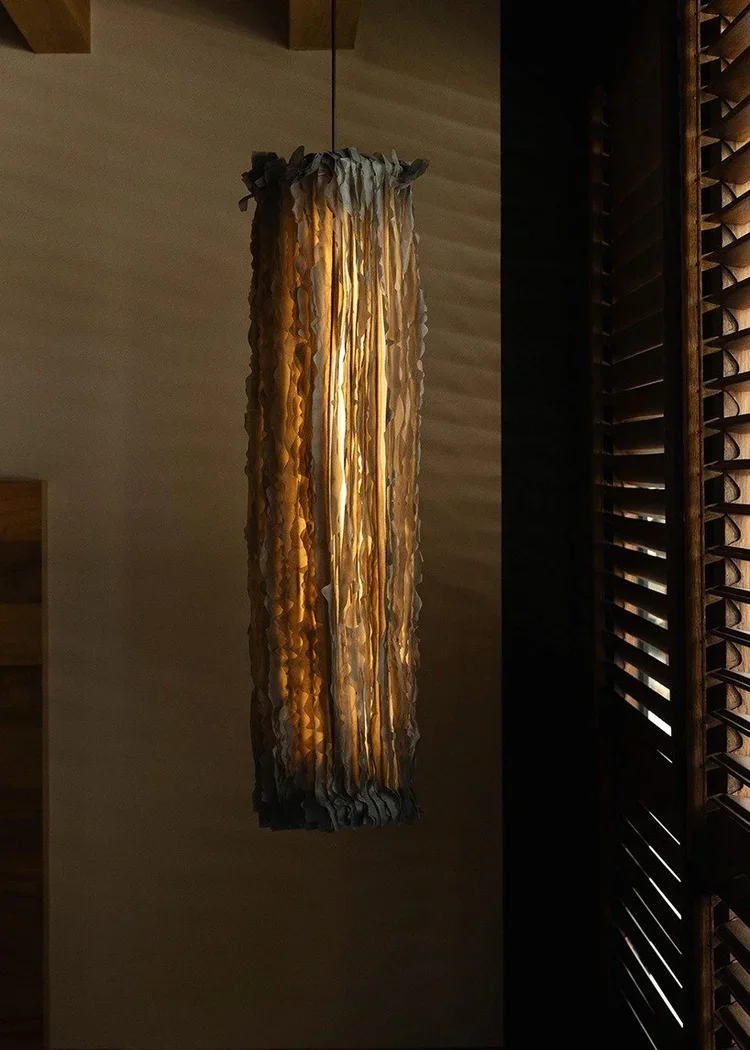
Lapso–Celium series by Polybion and Natural Urbano
And notice what quietly flips when a lamp becomes a fermentation record. The hierarchy between “finish” and “process” collapses. The fetish of flawless surfaces—the modernist obsession with the pristine plane—starts to feel like a social anxiety, not a design ethic. Bacterial cellulose doesn’t give you the comfort of sameness. It gives you a skin that reveals how it was fed, how it was dried, where it thickened, and where it thinned. It’s not a defect; it’s testimony.
Or consider BactoBerries by Debarati Das, which approaches material through intimacy rather than spectacle. It asks what “clean” might mean in the context of water scarcity and proposes a shift from sterilising the body to strengthening its own microbial ecosystem. Seeds, plant waste, and bio-based components become pods—objects that carry a quiet provocation: hygiene doesn’t have to be domination. Even here, in the private theatre of skin, the human is not alone; we are a habitat.
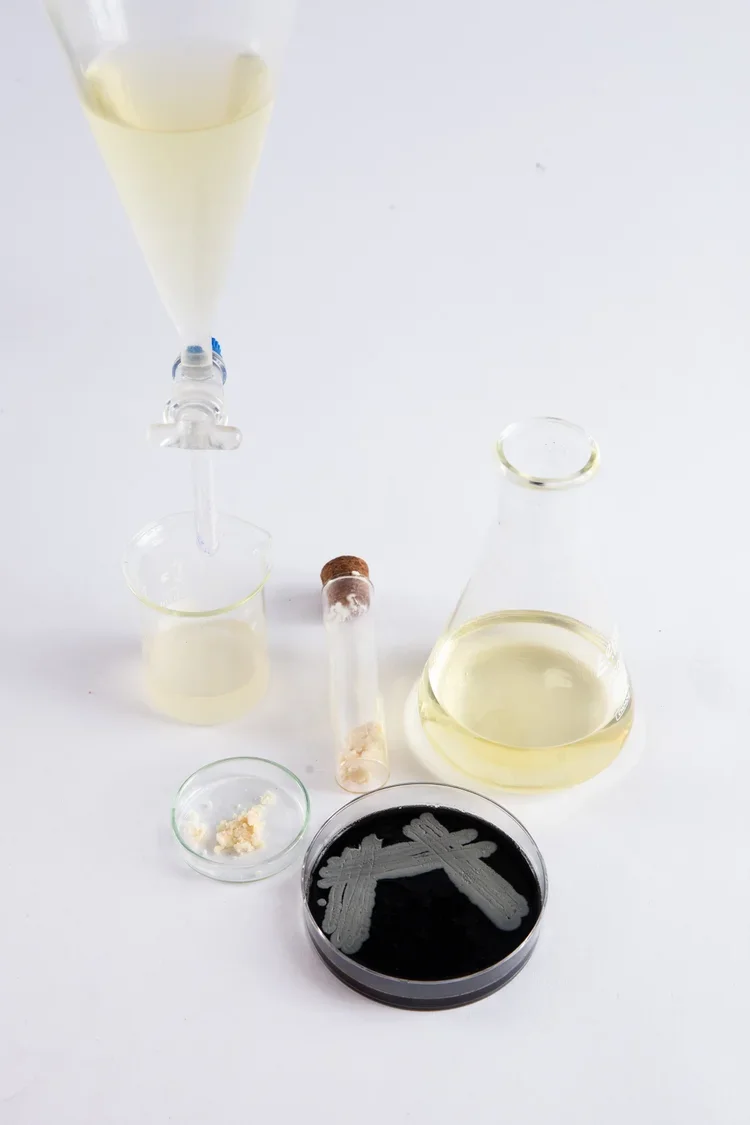
BactoBerries by Debarati Das
It’s also a reminder that “sustainability” is not only about carbon charts. It’s about the stories we tell ourselves to justify control. The modern hygiene regime was built on warfare metaphors—kill germs, defeat bacteria, purify surfaces—until we forgot that we are composed of microbial communities. When BactoBerries frames care as collaboration, it doesn’t just redesign a product; it nudges a worldview.
Mycelium, meanwhile, behaves like a curator with no interest in your schedule. It reorganises agricultural waste and fibres into new structures, but the “new” it produces is never the polished newness of industry. It comes with dirt-smell, uncertainty, and a slight insistence that your control is partial. You can design a form, yes—but you’re really designing a climate: warmth, humidity, nutrition, time. The mycelium replies, but it doesn’t obey. In that sense, it’s a material that trains humility.
That humility should extend to how we present ourselves. A mycelium sculpture under sealed acrylic can feel like a hostage situation: the institution insisting on stability, the organism insisting on life. The more interesting exhibitions treat the work as a time window rather than a trophy—allowing growth, documenting shifts, accepting moments of collapse as part of the piece’s statement. Not “maintenance” in the usual sense, but stewardship.
And then there is algae—especially when algae crosses from the food system into the material system. Hello! Algae by Zhenjing Lang reframes spirulina cultivation as a domestic, urban ritual. You don’t merely use algae; you watch it, feed it light, learn its moods. Nature ceases to be a distant landscape and becomes a relationship on your countertop. When algae becomes bioplastic, the critique sharpens. It looks like plastic, but refuses plastic’s most devastating promise: endurance without responsibility. It can deform, soften, break down—reminding us that what we’ve called “quality” is often just the violence of delayed decomposition.
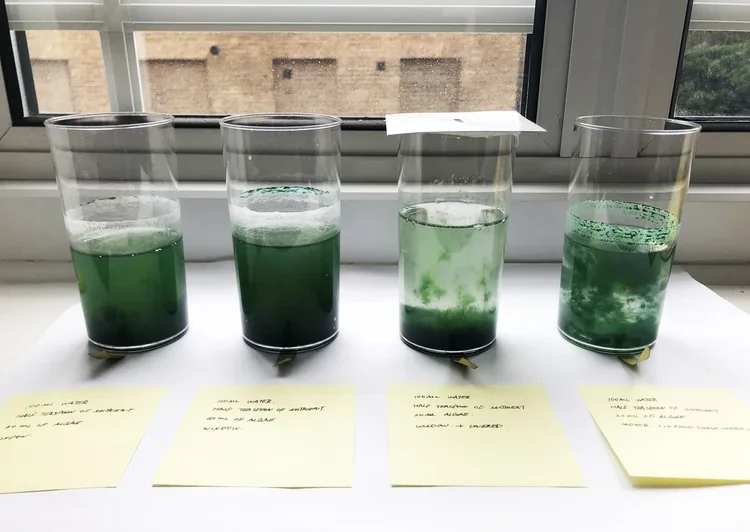
Hello! Algae by Zhenjing Lang
This is exactly why the current design world’s obsession with biomaterials can feel so bitter. Too often, biomaterials are treated as a fashionable veneer: a little mycelium here, a little algae there, and suddenly a project claims moral exemption. Greenwashing thrives on gestures—on the consumption of “saving” as an aesthetic pose. We’re not always saving the planet; sometimes we’re simply monetising the feeling of being the kind of person who would.
There’s a familiar visual language to this: earthy palettes, petri-dish photography, ritual close-ups of hands touching “alive” surfaces. The images are persuasive; the systems behind them are often unchanged. A biomaterial sample becomes a prop while the product pipeline remains extractive, the packaging remains glossy, and the distribution remains carbon-heavy.
The antidote is not purity. It’s honesty—and a willingness to let biomaterials do what they do best: disrupt the fantasy of permanence. Luffa Stoolita by Justin Wan’s team is compelling in precisely this way: using luffa fibres, coffee grounds, and clay-rich soil to produce a stool that doesn’t pretend to be immortal. Its strength is real, but so is its vulnerability. It carries an implicit message that industrial furniture has spent a century trying to erase: degradation is not a defect; it’s part of the contract.
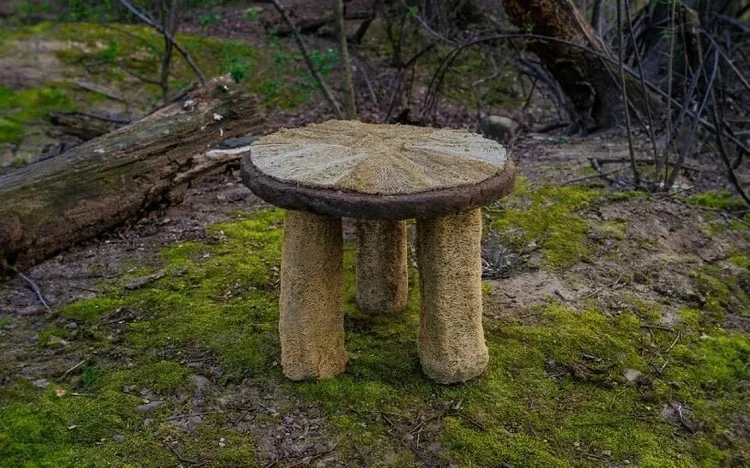
Luffa Stoolita by Justin Wan’s team
A compostable object asks for a different kind of ownership: not the right to keep, but the responsibility to return. It suggests that disposal is not an afterthought; it’s an authored phase of the design. A stool that can eventually rejoin the soil doesn’t just solve a waste problem—it rewrites the timeline of what furniture is allowed to be. It makes the end visible at the beginning.
Non-human centric thinking—symbiotic aesthetics, if you prefer—shouldn’t be a trendy frame pasted onto objects. It’s an ethic of relinquishing control. If we take biomaterials seriously as co-authors, we have to accept that we too will be changed: by the materials’ timelines, by their decay, by the fact that the artwork may refuse to remain what it was.
So we return to the hard question: if a work is designed to rot, what becomes of its value?
Maybe we need new verbs. Instead of asking how long a piece will last, we ask how it returns. Instead of worshipping the “forever object,” we learn to design dignified disappearance. In that shift, art ceases to function as a monument to industrial civilisation and instead participates in cycles: growth, use, breakdown, nourishment, reformation.
The final insight is blunt, almost earthy: matter has never belonged to us. “Eternity” is often just a technical method for hiding decay. “Progress” is frequently the power to postpone decomposition—and outsource it elsewhere. Biomaterials bring the outsourced half back into view. They invite art to stop performing immortality and start practising reciprocity.
Not everything needs to endure. Some things need to be composted.
Bibliography
Barad, K. (2007) Meeting the Universe Halfway: Quantum Physics and the Entanglement of Matter and Meaning. Durham, NC: Duke University Press.
Bennett, J. (2010) Vibrant Matter: A Political Ecology of Things. Durham, NC: Duke University Press. Braidotti, R. (2013) The Posthuman. Cambridge: Polity Press.
Cheah, W.Y. et al. (2023) ‘Current status and perspectives of algae-based bioplastics: A reviewed potential for sustainability’, Algal Research, 71, 103078. doi:10.1016/j.algal.2023.103078.
Gregory, D.A. et al. (2021) ‘Bacterial cellulose: A smart biomaterial with diverse applications’, Materials Science and Engineering: R: Reports, 145, 100623. doi:10.1016/j.mser.2021.100623.
Haraway, D.J. (2016) Staying with the Trouble: Making Kin in the Chthulucene. Durham, NC: Duke University Press.
Ingold, T. (2007) ‘Materials against materiality’, Archaeological Dialogues, 14(1), pp. 1–16. doi:10.1017/S1380203807002127.
Jones, M. et al. (2017) ‘Mycelium composites: A review of engineering characteristics and growth kinetics’, Journal of Bionanoscience, 11(4), pp. 241–257. doi:10.1166/jbns.2017.1440.
Chthulucene. Durham, NC: Duke University Press. Ingold, T. (2007) ‘Materials against materiality’, Archaeological Dialogues, 14(1), pp. 1–16. doi:10.1017/S1380203807002127.
Jones, M. et al. (2017) ‘Mycelium composites: A review of engineering characteristics and growth kinetics’, Journal of Bionanoscience, 11(4), pp. 241–257. doi:10.1166/jbns.2017.1440.
Das, D. (2024) ‘BactoBerries’, Art and Materials Lab, 21 October. Available at: Art and Materials Lab (Accessed: 4 February 2026).
Wan, J. (2024) ‘From Chow to Chair — Luffa Stoolita’, Art and Materials Lab, 3 March. Available at: Art and Materials Lab (Accessed: 4 February 2026).
Polybion (2025) ‘Lapso – Celium’, Art and Materials Lab, 21 September. Available at: Art and Materials Lab (Accessed: 4 February 2026).
Lang, Z. (2023) ‘Hello! Algae’, Art and Materials Lab, 18 November. Available at: Art and Materials Lab (Accessed: 4 February 2026).
Responsible Editor
Isabel Pavone