Synapses in the Weft: When Smart Textiles Start Sensing the World for Us
You walk into a room, and the first thing you notice isn’t the artwork—it’s the air. Not the temperature, exactly, but the way the air seems handled: held in the folds, slowed down, then released through fibre like a long breath you didn’t know you were taking. A textile hangs in space like an animal that has learned to stay very still. Then someone shifts their weight. A heel taps. The cloth answers with a faint tightening along its edge, as if it’s listening with a body rather than ears.
Textiles tempt the hand in a way painting rarely does. Even the most disciplined viewer has that small, involuntary twitch: the urge to test the surface, to confirm with skin what the eyes have been promised. Museums know this, which is why the most common sentence in a textile gallery is also the most infantilising one: Please do not touch. Smart textiles complicate that etiquette. They invite contact, then make contact consequential. Suddenly, touch isn’t just a breach of protocol—it’s participation, it’s input, it’s the thing that completes the work.
Fabric has always been intimate technology. It keeps the scent of shampoo, the trace of smoke, the impatient pull of a sleeve. It learns bodies and rooms—softening architecture, muffling sound, holding heat. For centuries, though, textiles have mostly played the dutiful role: the cover, the lining, the backdrop. Even when they were lavish, they were expected to be still.
That expectation is being rewritten. A growing wave of contemporary textile art refuses to remain a “surface.” It wants to be an organ. It wants feedback. It wants to act. The tapestry is no longer content to remember; it wants to respond—sometimes tenderly, sometimes defensively, sometimes like a machine trying to impersonate care. And once you’ve watched fabric respond, it’s hard to return to the old idea that cloth is only background.
I keep thinking about this shift—this move from static covering to interactive medium—through a few projects you’ve published on Art and Materials Lab, because they don’t treat sensing as a gimmick. They treat it as a problem: what happens to touch, to labour, to intimacy, when the weave starts “reading” the world?
Take Ievy Lin’s Unexpected yet nice touch. It doesn’t arrive waving the flag of technology. It arrives as a small, precise disturbance between what the eye believes and what the hand discovers. The work leans into that private moment of doubt—Is this what I thought it was?—and makes the doubt linger. Colour becomes misdirection. Finish becomes a trapdoor. The “nice touch” is nice because it is not fully obedient; it slips away from certainty, and your fingertips have to renegotiate their confidence.
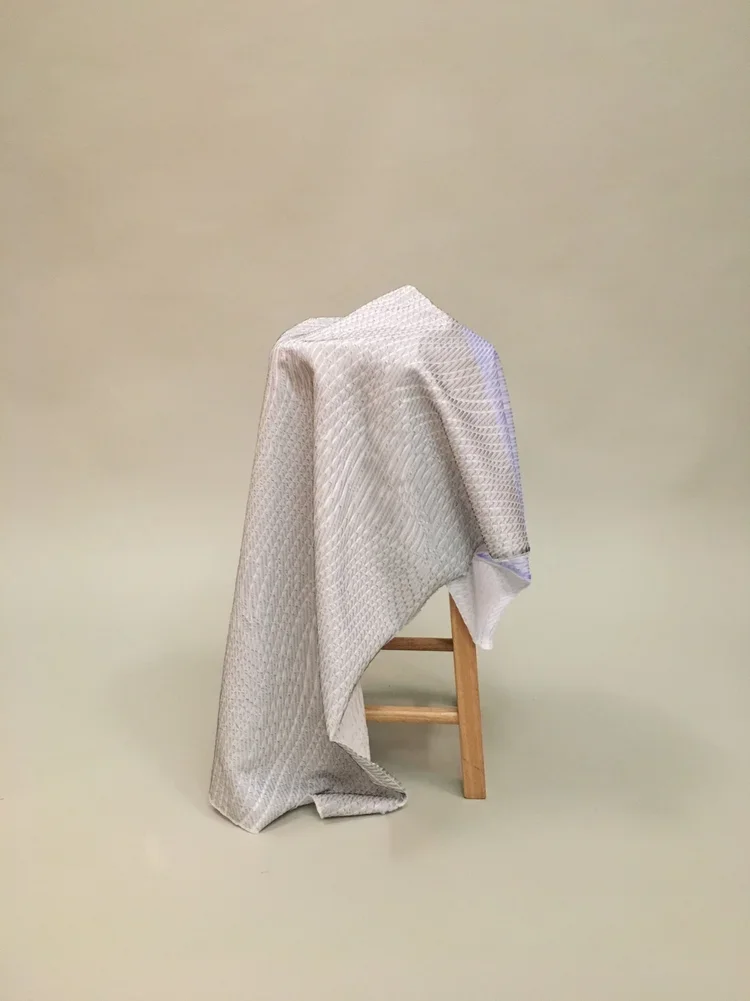
Ievy Lin’s Unexpected yet nice touch
That cultivated misalignment is exactly where smart textiles begin to feel inevitable. Once fabric starts sensing, it doesn’t simply gain a new function; it re-orders the hierarchy of your senses. It asks you to renegotiate the old contract: you touch, it stays still; you look, it stays mute. What happens when cloth answers back—and when the answer arrives as tightening, warmth, light, or a barely audible shiver?
Jie Lin’s SensitiveMe pushes the question into the territory of mood—colour not as decoration but as a physiological lever. There’s a reason her research touches hospital palettes, those carefully controlled atmospheres where a shade can sedate or alarm. The textile becomes a regulator: light and hue shifting like a nervous system trying to settle itself, or trying to settle you. You come to observe, and you realise—uncomfortably—that you’re being tuned.
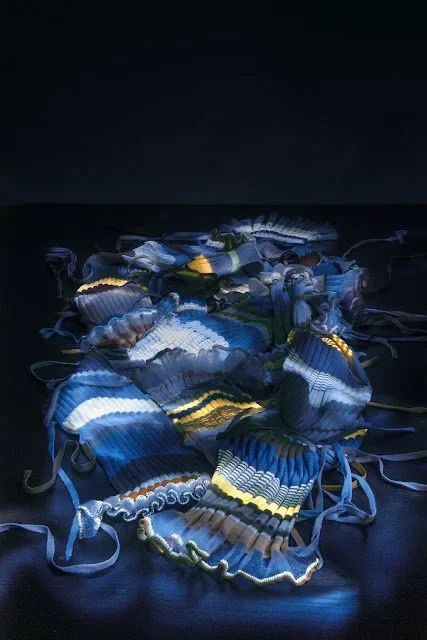
Jie Lin’s SensitiveMe
Now imagine those instincts—the doubt in touch, the modulation of feeling—wired into matter that literally performs.
Shape-memory alloy (SMA) is the blunt instrument that makes poetry possible. It’s often introduced as a clever trick (“metal that remembers”), but in textile work, it behaves less like a trick and more like a muscle. Under heat or electrical current, it tightens, flexes, and returns. The fabric gains posture. It can arch. It can brace itself. It can recoil like skin that has been startled. A hanging textile with SMA doesn’t “move” so much as compose itself: gathering into pleats like a shoulder gathering into tension, then releasing with the tired grace of exhaling.
Sometimes the movement is almost embarrassing in its intimacy. A seam tightens as if swallowing a thought. A panel warms like a cheek, heat travelling outward in a slow blush. You don’t read these shifts as mechanics—you read them as feeling, even when you know better. That’s the trick and the risk: the work borrows the grammar of the body, and your body answers in the same language.
Conductive polymer fibres take you further in. They aren’t muscles. They’re nervous. They register small pressures, the drag of a palm, the extra weight of humidity in the air. Woven through cloth, these fibres turn fabric into a sensing field. Touch is no longer an event that ends at the fingertip; touch becomes a trace that can be stored, compared, and interpreted. Even hesitation becomes information: the hand that hovers, the body that chooses not to touch.
And then there’s fibre-optic weaving, which is where the whole thing starts to feel like a gaze.
We’re used to light arriving at textiles—spotlights, windows, screens. Fibre optics makes light come from within, as if the cloth has grown a circulatory system. The weave begins to glow not as an “effect,” but as a condition. When a viewer approaches, the glow can thicken, shift, or flicker. Not just on/off but a vocabulary: density, direction, tempo. It’s difficult not to read it as attention.
There’s also a new kind of backstage labour attached to these “living” textiles: calibration, charging, debugging, replacing a snapped connection that behaves less like a thread and more like a nerve ending. The work may look soft, but it depends on a hard ecology—power, firmware, fragile joints, the quiet anxiety of obsolescence. In that sense, the friction isn’t only between technology and craft; it’s between two maintenance cultures. One is the slow repair of the fibre. The other is the fast repair of systems that would rather be updated than mended.
This is where the room changes. You realise the work isn’t merely illuminated; it performs awareness convincingly enough to reorganise your body. You lower your voice. You slow down. You become careful, the way you do around animals whose intentions you don’t fully understand.
People like to call this moment Digital Craftsmanship, as if the phrase could smooth out the friction. It tries to reconcile two histories: the slow intelligence of the hand and the quick intelligence of the circuit. Sometimes the reconciliation works. Sometimes it feels like a polite takeover. Code arrives as “assistance,” but assistance can quietly dictate the terms.
Because the hand has its own archive. Traditional textiles preserve labour in their imperfections: the slightly uneven tension, the stubborn knot, the tiny correction that remains visible because there was no time—or no desire—to erase it. That’s not just texture. That’s memory: of fatigue, of repetition, of skill earned and sometimes lost mid-process. We come to textiles for softness, but we stay for evidence—proof that someone spent hours negotiating with matter.
With responsive cloth, authorship also shifts. The artist doesn’t only design form; they design behaviour—if/then conditions, thresholds, moods. The finished object is partly a score, waiting for bodies and weather to perform it. That can be exhilarating: viewers become co-authors. It can also feel like a trap when participation is assumed, and the work quietly punishes refusal.
Smart textiles risk replacing labour memory with a different archive: frictionless, instantaneous, clean. When cloth becomes too responsive, too fluent, too good at performing life, what gets edited out is the very thing we often come to textiles for—the evidence of time. If everything is optimised, where does intimacy live?
Yet it would be lazy to frame this as a simple death of craft. Some of the most forward-looking work isn’t about sensors at all—it’s about the intelligence of material life cycles, and the moral weight of what we choose to keep forever.
Zhixin Xue’s Milk leather—biomaterial derived from casein in expired milk—does something quietly radical: it grants the material a dignified exit. It insists that value can include biodegradation, that an object can be designed to leave without violence. In a culture obsessed with durability, choosing to disappear can be a form of integrity.
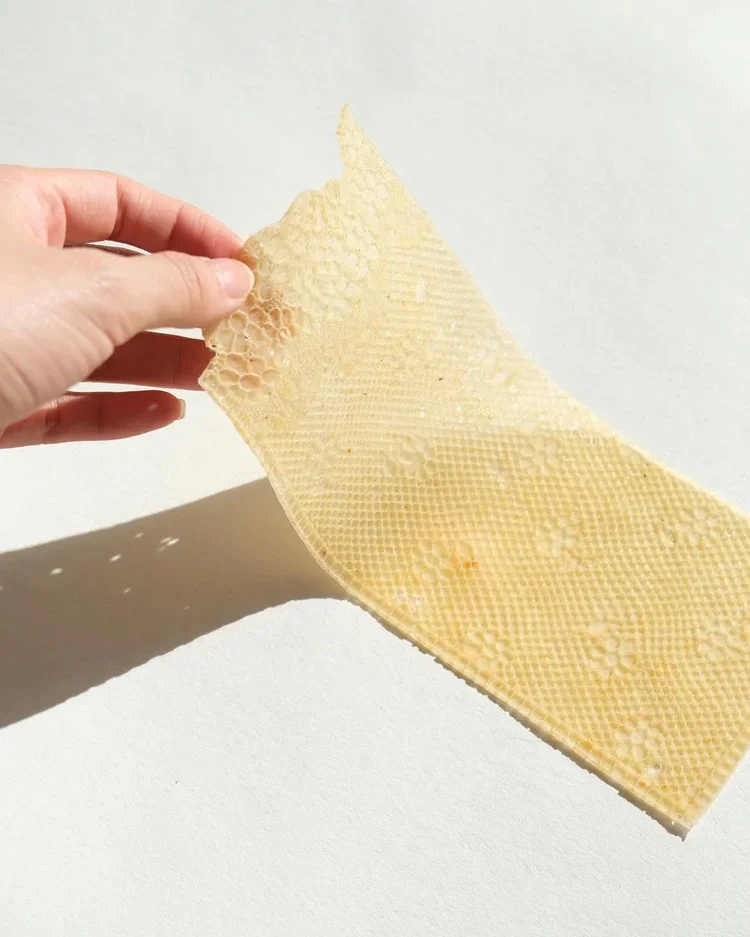
Zhixin Xue’s Milk leather
Amy Hsu Tzu Chen’s Exploring the Soft Resilience Within offers an equally sharp reminder: “movement” does not belong exclusively to electronics. Working through crochet, weaving, and wrapping—techniques tied to domestic labour and the politics of softness—she pairs pliancy with tension: wire, metallic twists, pipe cleaners, everyday flexible materials that bend by holding strain inside themselves. The work asks you to participate. It reminds you that responsiveness can come from structure and discipline, not only from computation.
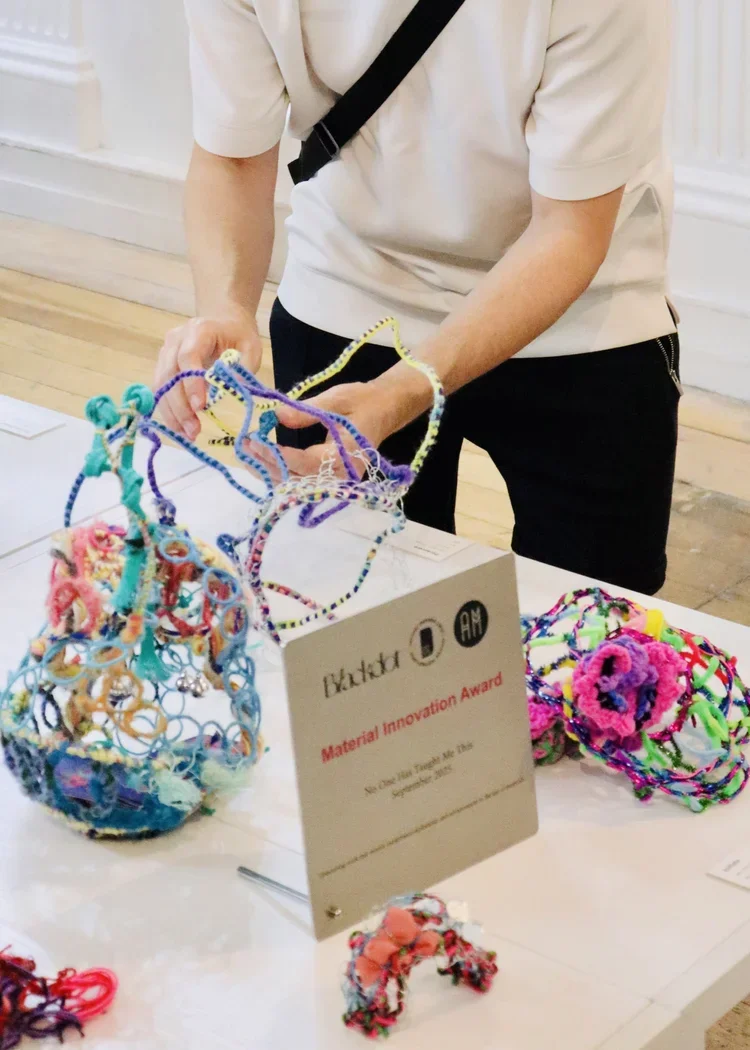
Amy Hsu Tzu Chen’s Exploring the Soft Resilience Within
All of this circles back to the question we keep trying not to ask out loud: when textiles start sensing, who is sensing whom?
There’s a seductive narrative that smart garments and perceptive tapestries are simply extensions of the human body—extra skin, extra intuition, a gentle upgrade. The phrase “posthuman sensing” often arrives dressed as liberation: expanded perception, distributed intelligence, a softer relationship between organism and environment.
Art can pretend this doesn’t matter because it calls itself “speculative,” but speculation has consequences. If a sensing textile is truly an extension of the body, then it deserves the ethical standards we reserve for bodies: consent, boundaries, and the right to opacity. Who owns the signals a garment collects? Who decides which sensations count as “noise,” which become “insight,” which are sold as wellness, security, or productivity? In the gallery, those questions can be obscured by beauty. Outside, they become policy.
But textiles have always been intimate technologies. When you add sensing, you add legibility—and legibility is never neutral. It can be care, yes, but it can also be extraction. Once emotion becomes measurable, it becomes governable. Once the body’s small fluctuations are captured, they can be modeled—and once modeled, they can be used.
Picture it late at night on the Underground. You’re wearing a jacket threaded with SMA and conductive fibres. A gust hits the platform; the collar pulls itself closer to your neck. Your heart rate lifts anyway—an older animal fear, the kind no amount of modern lighting really erases. The cuff responds: a faint ring of fibre-optic light, soft as a pulse, as if the garment is saying, I’m here.
And maybe it is.
Or maybe it’s saying something else—something you can’t hear. Not to you, but about you.
If fabric can learn your body this well, the question isn’t whether textiles will become more “alive.” The question is: when the cloth starts keeping count of your sensations, who gets to read the tally—and what do they do with it?
Bibliography
Ajana, B. (2020) ‘Personal metrics: users’ experiences and perceptions of self-tracking practices and data’, Social Science Information, (4), pp. 654–678. doi: 10.1177/0539018420959522.
Bryan-Kinns, N., Liu, Y., Zhang, D., Tan, Z. and Tan, H. (2024) ‘The role of digital technologies in contemporary craft practice from UK–China insights’, Journal of Contemporary Chinese Art, 11(1), pp. 75–93. doi: 10.1386/jcca_00093_1.
Fang, C., Shao, L., Wu, S., Niu, W., Sui, K. and An, J. (2024) ‘Advanced design of fibrous flexible actuators for smart wearable applications’, Advanced Fiber Materials, 6(3), pp. 622–657. doi: 10.1007/s42765-024-00386-9.
Forlano, L. (2017) ‘Posthumanism and design’, She Ji: The Journal of Design, Economics, and Innovation, 3(1), pp. 16–29. doi: 10.1016/j.sheji.2017.08.001.
Gong, Z., Xiang, Z., OuYang, X., Zhang, J., Lau, N., Zhou, J. and Chan, C.C. (2019) ‘Wearable fiber optic technology based on smart textile: a review’, Materials (Basel), 12(20), 3311. doi: 10.3390/ma12203311.
Liu, Y., Yang, F., Li, B., Pan, L., Cao, J., Tao, L., Li, Y., Zhang, L., Zhang, W., Song, Z., Zhang, Y., Cheng, X., Ren, J., Wu, J., Yu, Y., Zhang, Y., Wang, W., Wang, M. and Zheng, Z. (2025) ‘Sensory interactive fibers and textiles’, npj Flexible Electronics, 9, 23. doi: 10.1038/s41528-025-00398-4.
Lupton, D. and Maslen, S. (2018) ‘How does the more-than-human sensorium feel? Self-tracking and the senses’, The Senses and Society, 13(2), pp. 190–202. doi: 10.1080/17458927.2018.1480177.
Srivastava, R., Alsamhi, S.H., Murray, A., Devine, P. and Casula, G.A. (2022) ‘Shape memory alloy-based wearables: a review, and conceptual frameworks on HCI and HRI in Industry 4.0’, Sensors, 22(18), 6802. doi: 10.3390/s22186802.
Tseghai, G.B., Mengistie, D.A., Malengier, B., Fante, K.A. and Van Langenhove, L. (2020) ‘PEDOT:PSS-based conductive textiles and their applications’, Sensors, 20(7), 1881. doi: 10.3390/s20071881.
Varisco, A.V.A., Ponzoni, M.P. and Suls, D.S. (2025) ‘“Digital craftsmanship” as a methodology for fashion research’, European Journal of Cultural Management and Policy, Volume 15 (2025). doi: 10.3389/ejcmp.2025.14770.
Lin, I. (2020) ‘Unexpected yet nice touch’, Art and Materials Lab, 19 April. Available at: Art and Materials Lab (Accessed: 3 January 2026).
Lin, J. (2023) ‘Sensitiveme’, Art and Materials Lab, 18 November. Available at: Art and Materials Lab (Accessed: 3 January 2026).
Xue, Z. (2023) ‘Milk leather’, Art and Materials Lab, 18 August. Available at: Art and Materials Lab (Accessed: 3 January 2026).
Chen, A.H.T. (2025) ‘Exploring the Soft Resilience Within’, Art and Materials Lab, 21 October. Available at: Art and Materials Lab (Accessed: 3 January 2026).
Responsible Editor
Isabel Pavone