Along a carved wooden rim, the grain gives the eye a direction to follow. A finger might find that direction differently, moving easily along a fibre and meeting resistance across it. On a surface containing crushed shell, attention shifts to the spaces between particles. Something has to hold those fragments together. Before either material can be called sustainable, there is a small, practical question to settle: what happens at that surface when somebody uses it, cleans it and comes back tomorrow?
Ash Pales's Stitch and Fahrenheit 180º's From the Tagus to the Tile approach recovered matter through different structural decisions. Pales carves timber while keeping its grain. Fahrenheit 180º makes a new surface from fragmented shell and a binding material. Both ask discarded resources to do useful work again. Together, they raise a question that reaches beyond their ingredients: how much should a material change to give it another life?
Art & Materials Lab identifies the timber in Stitch as black ash from Ealing and plum from Camden, recovered from trees felled after disease. Carving lets biological variation remain part of the object, rather than turning the whole resource into an anonymous mixture. The visible grain matters here. It gives the maker an existing arrangement to work with, including its irregularities. Yet a mark that makes a piece visually compelling cannot tell us how much sound material remains. Discolouration and mechanical condition need separate attention.
Wood has already done much of its own construction. Cellulose microfibrils lie within a surrounding matrix that includes hemicelluloses and lignin; their arrangement helps explain why a piece behaves differently along and across the grain. Emil Engelund Thybring and colleagues show why water belongs inside this account of structure. Moisture entering the cell wall can change dimensions and behaviour, while water occupying larger voids has a different role. Keeping the grain also means keeping these responses. A carved form must make room for them through its orientation, thickness, and conditions of use.
The choice to retain wood therefore involves more than deciding where to cut. Drying, sorting and the amount removed all affect what is recovered in practice. A small sound object might leave a large pile of unusable material, while another piece could yield several useful components. Morwenna Spear and colleagues' review of wood recycling follows routes into panels, fibres and other feedstocks. Those routes give irregular material more options, but they also bring new processing requirements. The sensible question is which use fits the piece available, including the labour and losses needed to get there.

Ash Pale's hand-carved, disease-felled black ash and plumb into everyday vessels, preserving fungal scars as tactile traces of urban weathering.
There are ways to change wood more deeply. Muhammad Awais and colleagues investigated chemical treatments that alter accessible hydroxyl groups and the space available to water within the cell wall. Their work helps distinguish changing where water can interact with wood from changing the space it can occupy. Such treatments are alternatives to investigate, rather than documented features of Stitch. For a maker considering them, a useful result would have to justify the added reagents and processing through better performance or longer use. A surface can keep the appearance of wood while its behaviour changes substantially.
From the Tagus to the Tile begins with a different inheritance. The Lisbon installation, exhibited in the Gulbenkian Garden in July 2025, brings oyster-shell material into the cultural setting of the Portuguese azulejo. Art & Materials Lab featured it in April 2026. Here the grain of a continuous piece has given way to particles, seaweed-derived binders and pigments. The tile remains a recognisable kind of surface, but its coherence must be remade. A fragment may retain a trace of its source while depending on a new connection to its neighbour.
That connection is where much of the work lies. The Gulbenkian residency account identifies pressing and natural binders such as agar-agar among the approaches investigated. Cleaning, crushing, mixing, forming and drying each become part of the material's route into use. Avoiding conventional ceramic firing is an interesting research direction, but it does not remove the need to account for those steps. To assess the exhibited tiles in detail, the final recipe, forming conditions, and drying requirements are needed.
Nor does a larger proportion of recovered shell necessarily make a better tile. Particle size, packing and empty spaces affect how a binder holds the material together. In Nor Azwin Ahad and colleagues' experiments with shell-filled epoxy, the useful loading depended on shell type; adding more filler did not keep increasing strength. The lesson extends to the questions asked of a new surface, rather than answering this one. A hard particle can still be part of a weak assembly if the connection around it is poor.
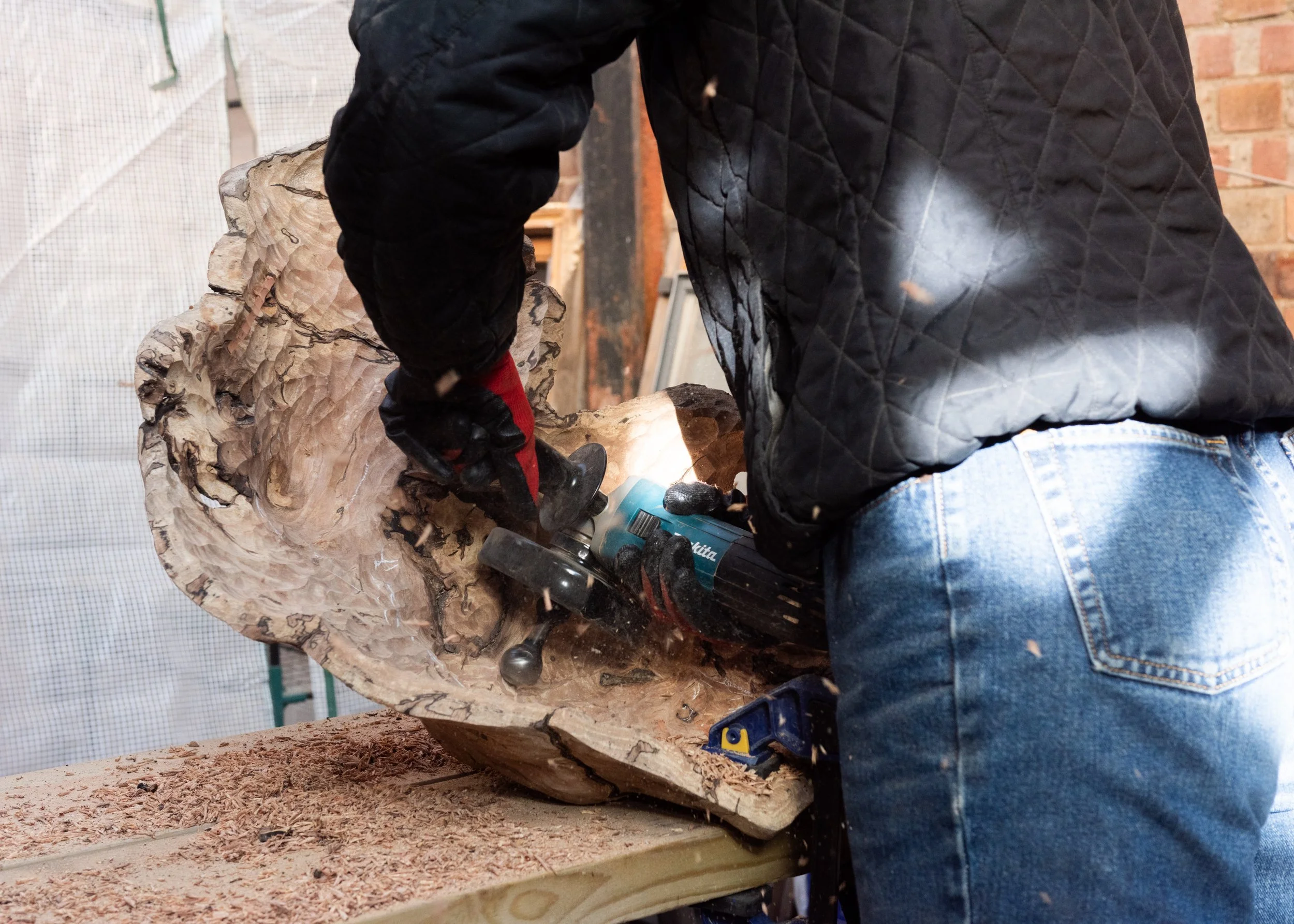
Stitch by Ash Pale suggests that preservation and disposal are interconnected and influence each other. Ultimately, the bowl retains its argument internally.
Binder choice also changes what kind of recovery is being attempted. A shell in an epoxy matrix remains part of a thermoset composite; the mineral's recovered origin does not make the matrix biodegradable. A lime-based route has its own heating and curing demands. Seaweed-derived formulations introduce other possibilities, but agar and calcium-crosslinked alginate are different systems. Swarup Roy and colleagues' review of agar films describes how brittleness and barrier behaviour depend on blending, plasticisers and other additives. These choices have consequences and are not interchangeable versions of a single natural binder.
A recent comparison by Paul Nicholas and colleagues makes the trade-off particularly clear. Their mussel-shell and alginate material performed better in compression than their calcined-shell formulation, while carrying higher modelled global warming potential and water consumption. These were separate laboratory materials, not measurements of Fahrenheit 180º's tiles. What makes the comparison useful is the difficulty it leaves intact: choosing a route with less firing does not, by itself, settle its environmental performance. Useful strength, processing inputs and the basis of the comparison still have to be considered together.
The research assembled across 2022–2026 brings these decisions into closer view. Studies of wood and water examine where moisture sits and how a cell wall responds; composite research follows the effects of filler loading and binder chemistry. Work on recycling and environmental assessment then asks what those choices mean over multiple uses. This reading covers representative studies, not a complete survey of the field. Its significance for the two projects is practical: knowing what a material contains is only the beginning of knowing how it will behave.
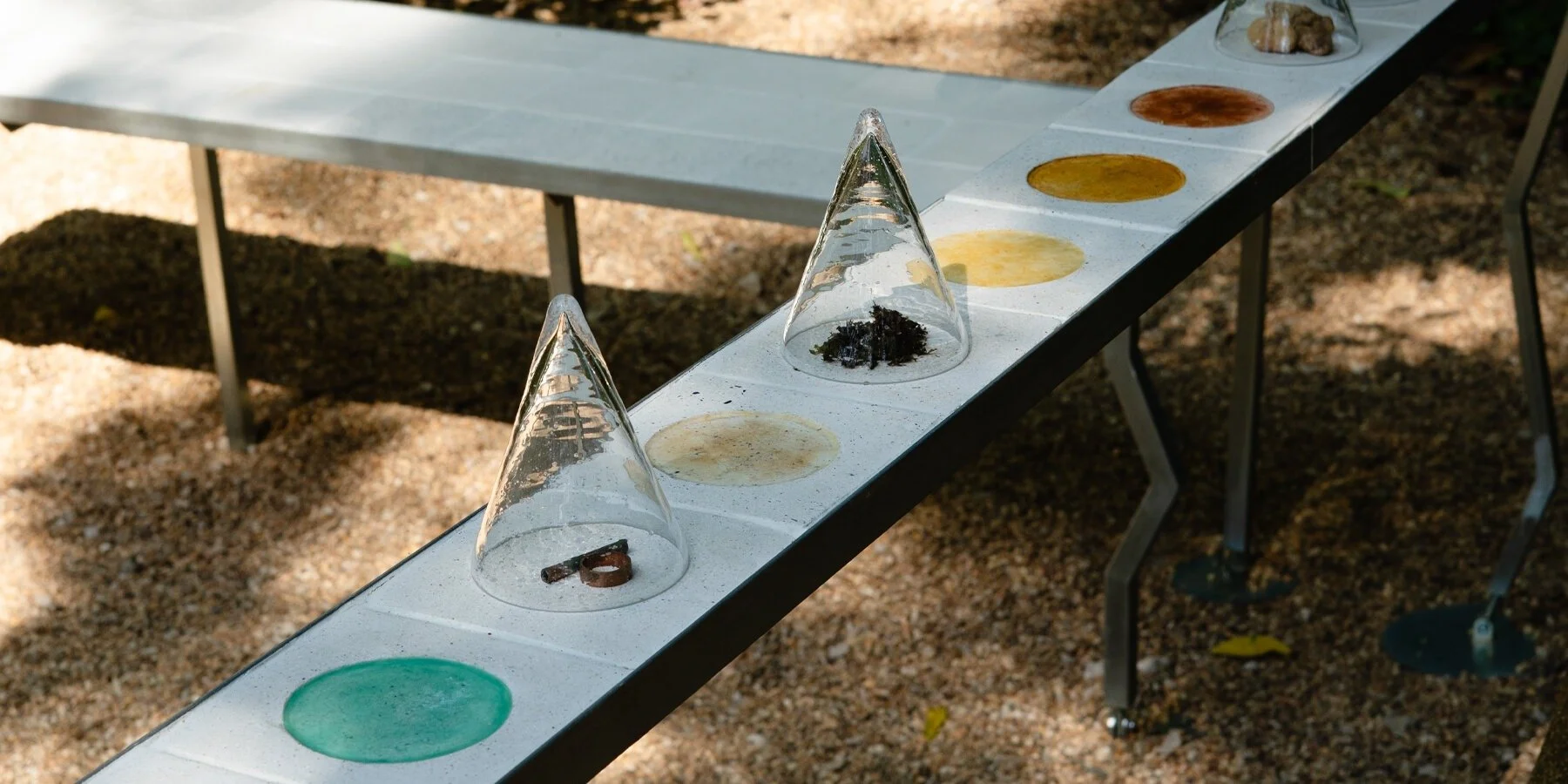
Fahrenheit 180º uses biodegradable, shell-textured forms in the Gulbenkian Garden to explore how cultural heritage and ecological experimentation can enrich one another.
Often the next decision is made at the surface. Lunjakorn Amornkitbamrung and colleagues combined shell-derived calcium carbonate, a surface treatment and ethyl cellulose to improve paper's resistance to liquid uptake. Their work concerns coated paper, but it shows how a binder and treated particles can work together to change wetting. A coating considered for a recovered material would need to be judged as part of the whole object: how it adheres, how it wears, what it feels like, and what happens when the object needs another route through recovery.
Touch gives that judgement a human scale. Warmth is not simply a colour, and smoothness is not simply an image. In Yue Zhang and colleagues' experiments on wood, visual and tactile information contributed differently to perceived warmth. The temperature at contact helped shape what people felt. That finding leaves a useful question for either project: could a treatment that protects the surface also change the quality that makes somebody want to handle it? The answer would need actual contact with tested samples. You can't read it from a photograph of grain or shell.
Consider the ordinary act of wiping an object down. A wet cloth brings water, pressure and friction together, then leaves the material to dry. It is a plausible point at which a grain could rise, a binding phase could soften, or an edge could begin to shed particles. None of those changes has been established for the selected works. They describe the kind of encounter that a laboratory programme should be able to explain. Callum Hill and colleagues' work on moisture-responsive materials is helpful here because it treats the material itself as changing during moisture uptake, rather than as a fixed network of pores through which water simply passes.
A useful investigation would follow that change through several scales. Controlled humidity steps could track mass and swelling together. Microscopy could locate a crack or separating interface; spectroscopy and mineral analysis could identify what the treatment changed. Mechanical testing would then ask whether stiffness or strength remained after exposure and after drying back. Roughness, friction and contact temperature could connect those measurements to handling. Sound during rubbing and relevant odour changes might offer further questions, if paired with suitable measurements. Such a programme would turn an everyday gesture into a sequence you can observe and compare.
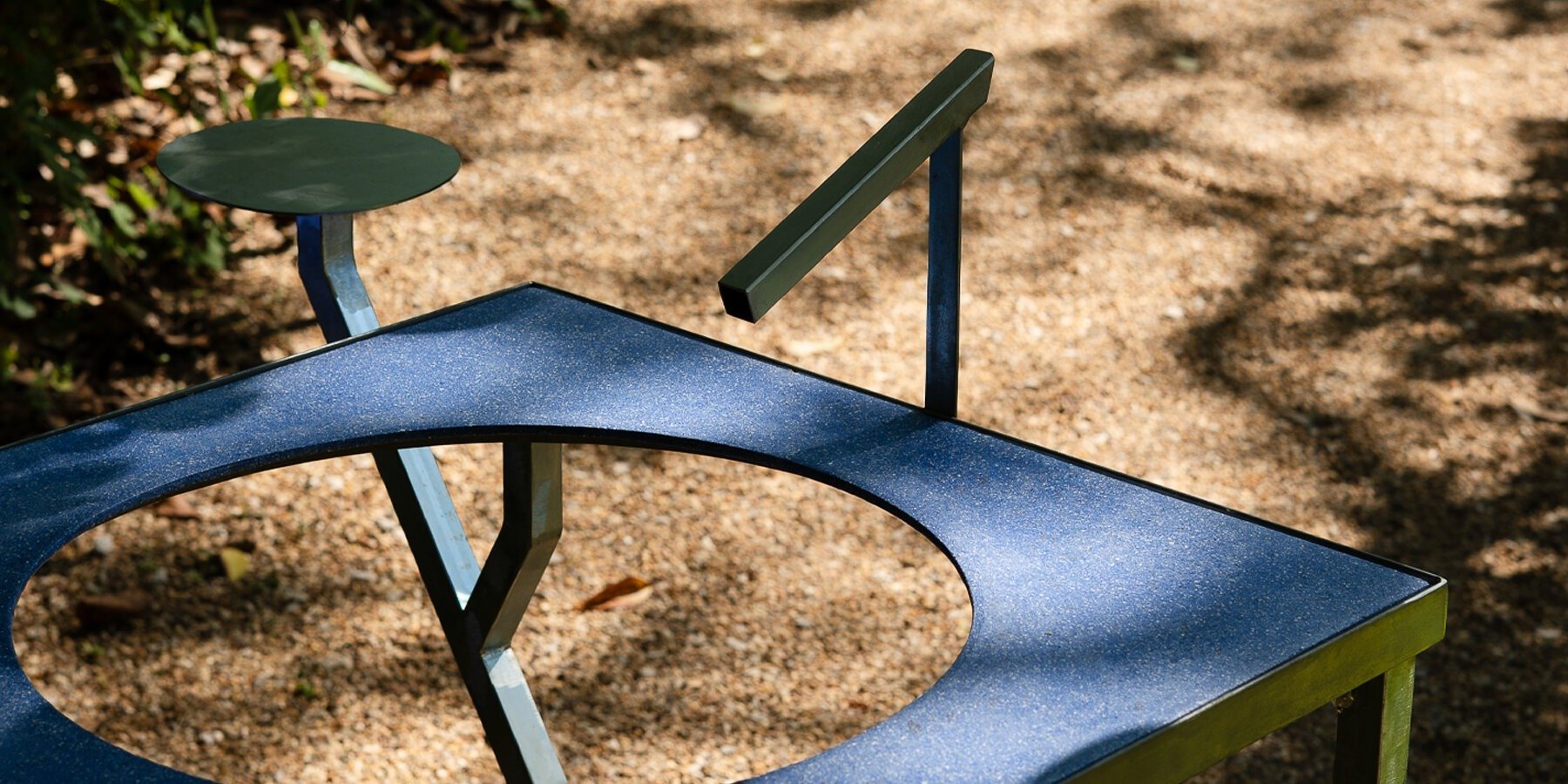
A Wearable Sound System: Fashion as Public Infrastructure by NiK Bentel Studio offers a transformative approach to experiencing sound in daily life.
The specimens would need their own histories. For wood, the study could compare sound and visibly altered regions from several traceable pieces, controlling orientation and moisture. For shell composites, it could vary particle grading, binder proportion and forming conditions while keeping agar and alginate series distinct. Untreated controls, suitable conventional references and repeated feedstock batches would help reveal whether an improvement belongs to the process or to one unusually good sample. Comparing the same property before exposure, during it and after reconditioning would distinguish temporary softening from lasting damage. These are proposals for future research, not tests already carried out on the works.
Environmental evidence needs the same attention to scale. In Khin Su Su Kyaw and colleagues' model of a Norwegian timber house, the highest-recovery scenario reduced fossil carbon footprint by only about two per cent relative to the baseline, while a measure that accounted for biogenic carbon differently changed much more markedly. The result cannot be transferred to a bowl. It does show why the word reuse cannot stand in for a full account. Collection, cleaning, drying, rejected material, maintenance and useful life all affect what a second use achieves.
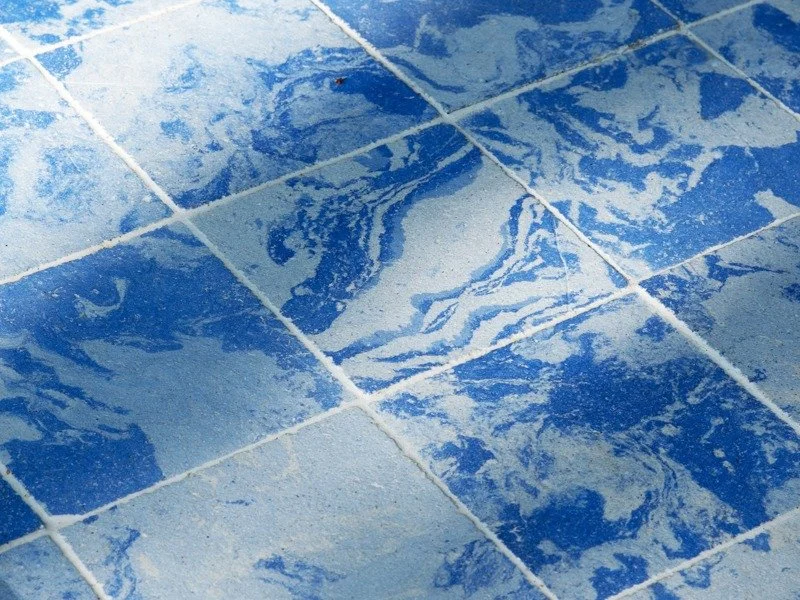
Fahrenheit 180º frames the limited durability of regenerative materials as a responsible design choice for temporary architecture and public or educational settings, allowing the azulejo’s cultural memory to return to the landscape through its gradual decay.
The promising research question is therefore how little transformation is sufficient for a particular job. A more intensive treatment might earn its cost by keeping far more material useful or extending its life. Another might add inputs without a worthwhile gain. Recording energy, water, reagents, yield and labour per usable component would make that choice easier to examine. So would following changes in feel alongside changes in strength. An object may cease to be welcome in daily use before it reaches a formal mechanical limit. Whether a roughening surface or an altered drag under the hand affects that decision deserves investigation.
At the rim of Stitch, the maker works with a continuity that was already there. At the shell surface, continuity has to be built between fragments. The shared task is to keep enough of that connection for the object to do its work, through the handling and cleaning its use requires. Sometimes that may mean leaving more of a material intact; sometimes it may justify changing it further. The place to begin remains close at hand: the edge that still feels coherent, and the particles that stay held when a cloth passes over them.
Bibliography
Art & Materials Lab (2026a). [Stitch — Ash Pales] (https://www.artandmaterialslab.com/materials/stitch-ash-pales). 1 February. Accessed 2 November 2026.
Art & Materials Lab (2026b). [From the Tagus to the Tile — Fahrenheit 180º](https://www.artandmaterialslab.com/spatial/from-the-tagus-to-the-tile). 14 April. Accessed 11 November 2026.
Centro de Arte Moderna Gulbenkian (n.d.). [Art & Design Residency ‘Radical Waters – Concrete Matters’](https://gulbenkian.pt/cam/en/projects/bauhaus-of-the-seas-sails/art-design-residency-radical-waters-concrete-matters/). Institutional project account. Accessed 2 November 2026.
Fundação Calouste Gulbenkian (2025). [Fahrenheit 180º. From the Tagus to the Tile](https://gulbenkian.pt/en/agenda/fahrenheit-180-from-the-tagus-to-the-tile/). Exhibition programme, 12–29 July 2025. Accessed 12 November 2026.
Thybring, E.E., Fredriksson, M., Zelinka, S.L. and Glass, S.V. (2022). Water in Wood: A Review of Current Understanding and Knowledge Gaps. Forests, 13(12), 2051. [DOI 10.3390/f13122051](https://doi.org/10.3390/f13122051).
Awais, M., Altgen, M., Belt, T., Teräväinen, V., Mäkelä, M., Altgen, D., Nopens, M. and Rautkari, L. (2022). Wood–Water Relations Affected by Anhydride and Formaldehyde Modification of Wood. ACS Omega, 7(46), 42199–42207. [DOI 10.1021/acsomega.2c04974] (https://doi.org/10.1021/acsomega.2c04974).
Ahad, N.A., Kwan, S.L. and Halim, K. (2023). The Effect of Seashells as Filler in Epoxy Composites. Science Letters, 17(2), 119–129. [DOI 10.24191/sl.v17i2.22751] (https://doi.org/10.24191/sl.v17i2.22751). [Publisher PDF](https://scilett-fsg.uitm.edu.my/images/ManuscriptTemplate/Volume17-2/10_SL_2023_ACP58_FORMATTED_01edited_03.pdf).
Hill, C., Altgen, M., Penttilä, P. and Rautkari, L. (2024). Review: interaction of water vapour with wood and other hygro-responsive materials. Journal of Materials Science, 59, 7595–7635. [DOI 10.1007/s10853-024-09636-y](https://doi.org/10.1007/s10853-024-09636-y).
Spear, M.J., Dimitriou, A., Curling, S.F. and Ormondroyd, G.A. (2025). Developments in the Recycling of Wood and Wood Fibre in the UK: A Review. Fibres, 13(2), 23. [DOI 10.3390/fib13020023](https://doi.org/10.3390/fib13020023).
Amornkitbamrung, L., Thanawinitcharoen, A., Lertvachirapaiboon, C., Ahn, C.-H., Ekgasit, S. and Rimdusit, S. (2025). Eco-friendly water barrier coating for paper packaging: Harnessing bio-calcium carbonate from mussel shell waste. Cleaner Materials, 16, 100318. [DOI 10.1016/j.clema.2025.100318](https://doi.org/10.1016/j.clema.2025.100318).
Nicholas, P., Gaudillière-Jami, N. and Ichniowski, C.-N. (2026). Marine Bio-Composites for Architecture: A Comparative Performance and Environmental Evaluation of Shell-Based Material Systems. Buildings, 16(22), 4543. Published 14 November 2026. [DOI 10.3390/buildings16224543](https://doi.org/10.3390/buildings16224543).
Kyaw, K.S.S., Liu, Y., Bohne, R.A., Kvande, T. and Huang, L. (2026). Influence of end-of-life pathways for reclaimed wood on environmental impacts: A scenario-based life cycle assessment of a Norwegian detached house. Construction and Building Materials, article 148288; online publication 24 October 2026. [DOI 10.1016/j.conbuildmat.2026.148288](https://doi.org/10.1016/j.conbuildmat.2026.148288). The accessible publisher record does not list the volume.
Zhang, Y., Xiong, W., Guo, Y., Wei, P. and Yi, S. (2025). Multimodal Evaluation of Warmth Perception in Wood: An Experimental Study Based on Visual, Tactile, and Visual-Tactile Interactions. BioResources, 20(3), 7495–7514. [DOI 10.15376/biores.20.3.7495-7514] (https://doi.org/10.15376/biores.20.3.7495-7514).
Roy, S., Chawla, R., Santhosh, R., Thakur, R., Sarkar, P. and Zhang, W. (2023). Agar-based edible films and food packaging application: A comprehensive review. Trends in Food Science & Technology, 141, 104198. [DOI 10.1016/j.tifs.2023.104198] (https://doi.org/10.1016/j.tifs.2023.104198).
Responsible Editor
Ethan Liu