A crease puts a narrow shadow into a sheet of paper. Change its angle and the shadow changes with it. A baguette offers another kind of edge: the crust holds its outline while the crumb encloses a less orderly field of cells. Before either becomes a design proposition, it has already arranged solid matter around space. That arrangement deserves as much attention as the substance listed in a caption.
Natchar Sawatdichai's Paper Blind and MERO Studios' Paysage de Pain, both featured by Art & Materials Lab in May 2026, make this a practical materials question. How can the spaces within and between materials perform useful work, and what does it cost to keep them doing it? The comparison concerns geometry, pore architecture and service life. It also requires a distinction between paper designed for recovery and bread already recovered from a waste stream.
Paper Blind uses a cut-and-creased sheet, folded and joined into a dimensional surface. A cord and pulley adjust its extent; the paper panel can be replaced while supporting components remain. Its environmental proposition lies partly in that division of responsibilities. The surface need not outlast every part of the mechanism. Whether replacement is worthwhile depends on the panel's useful life, the work of making it, and what happens to the removed sheet.
Folding also changes the mechanical problem. A sheet acquires depth and direction, yet its creases become places where deformation concentrates. Tomi Kankkunen and Jarkko Niiranen's 2025 finite element study treats cellulose sheets as orthotropic materials with nonlinear constitutive behaviour. Their work shows how geometry, material properties and imperfections influence fold formation. It offers a way to think beyond an ideal hinge drawn on a diagram. A real crease has width, a manufacturing history and a material response. Applying that approach to a moving blind would require its own measurements.
At the scale of the room, the useful output is light. There is little reason to judge a blind solely by how much load its sheet can carry. Relevant questions include whether a chosen configuration provides privacy, how evenly it distributes daylight, and how much force a person needs to adjust it. A laboratory might find a very strong sheet that makes an awkward blind. Geometry and handling must be specified together.
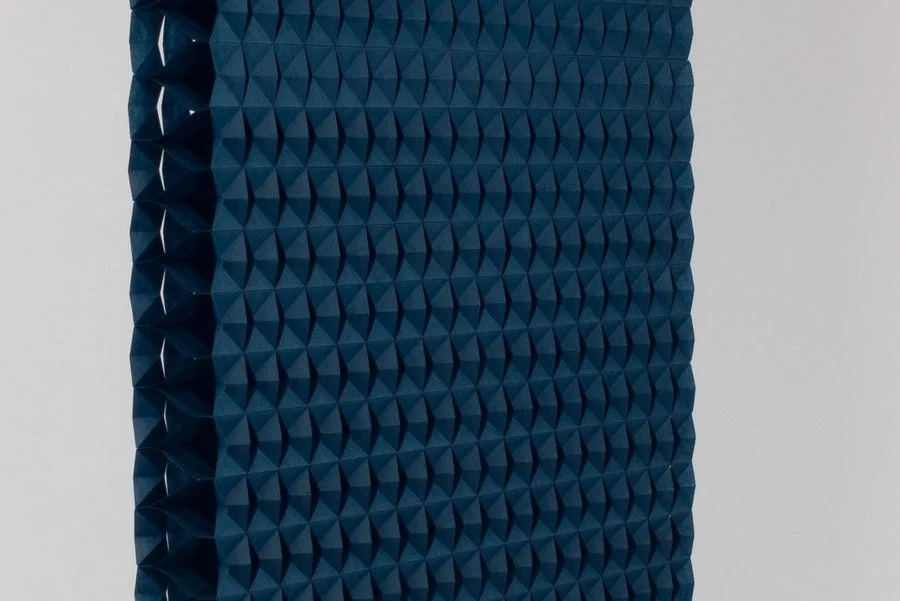
Paper Blind transforms folded paper into an adjustable, repairable window system that controls light, fits a range of openings, and minimises material waste.
MERO Studios brings a different material history into view. Its account of Paysage de Pain describes discarded baguettes, obtained through a Montpellier association, for a courtyard installation at the 2025 Festival des Architectures Vives. Bread remains recognisable in the assembly. That recognition gives the work cultural force: something normally held near the mouth is encountered at the scale of an enclosure. The eye can follow a familiar outline while the body negotiates a newly unfamiliar use.
The gaps between loaves and the cells inside bread belong to different structural scales. Openings in an enclosure may admit light or permit a view; the internal architecture of a porous solid may influence deformation, liquid uptake and heat transport. One cannot infer the second set of functions from a photograph of the first. Neither selected work has an established thermal or acoustic performance dataset in the sources examined here. The distinction matters when an arresting installation is read as a possible building material.
The solid has a history too. In Guo and colleagues' 2024 investigation of bread biopolymers, bread-making reduced amylopectin molecular mass and amylose chain length, alongside forming a gluten network. Heat and shear were implicated in molecular fragmentation. Thus the familiar crust conceals a resource already transformed by processing. A recovered loaf is a composite feedstock with a particular molecular history that must be understood before choosing its next transformation.
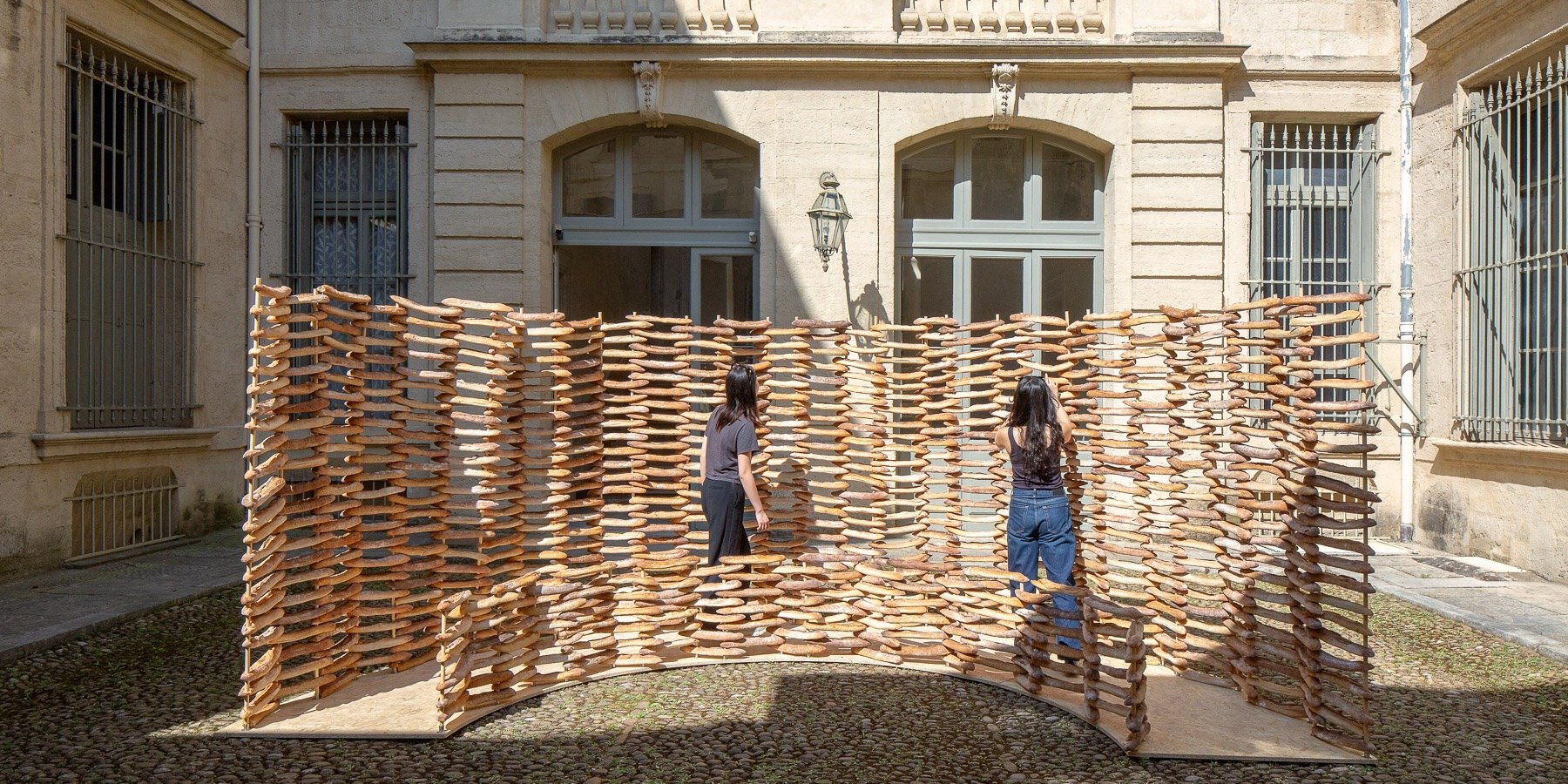
Paysage de Pain turns 780 discarded baguettes into an immersive pavilion that uses sensory experience and decay to highlight food waste and inspire cultural reflection and circular action.
Recent bread research makes the difference unusually clear. Wanxiang Guo, Tatiana Budtova and Mario M. Martinez converted stale bread into porous materials using gelatinisation and different drying routes. Their 2025 study found broadly similar porous properties for selected low-vacuum-dried xerogels and supercritically dried aerogels, while wheat-starch controls achieved greater compressive properties. The work opens a choice between processes. It does not establish that the Montpellier installation contains aerogel, or that an intact loaf has the properties of a reconstructed gel.
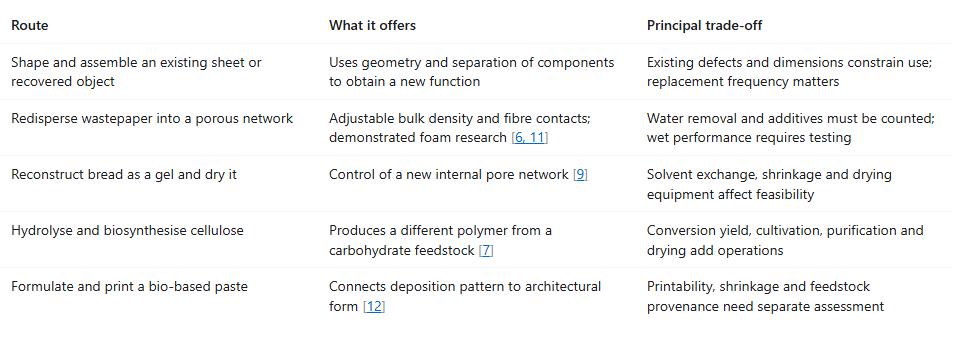
At this point, recycling becomes a question of which structure is useful enough to preserve and which must be made anew. Retaining a shape avoids some conversion steps but constrains the next application. Dispersing fibres, preparing a gel or converting carbohydrates into a microbial feedstock permits other structures, with additional demands for water, separation and drying. The right route depends on the required service. Making the most elaborate material from a residue is a different achievement from making the most useful one.
The five publication years from 2022 to 2026 show several research lines developing in parallel. Massimigliano Di Luigi and colleagues' 2022 silica–cellulose work combines recycled-paper-derived fibres with a porous inorganic phase and dries at ambient pressure. Bin Zhang and colleagues' 2023 wastepaper study develops lightweight foams with thermal and cushioning functions. By 2025–2026, the selected literature also connects drying choices, fold mechanics and printable architecture. Across this sample, a useful trend is the effort to control architecture and multiple properties together. It is an interpretation of representative papers, rather than a measured rise in publication numbers.
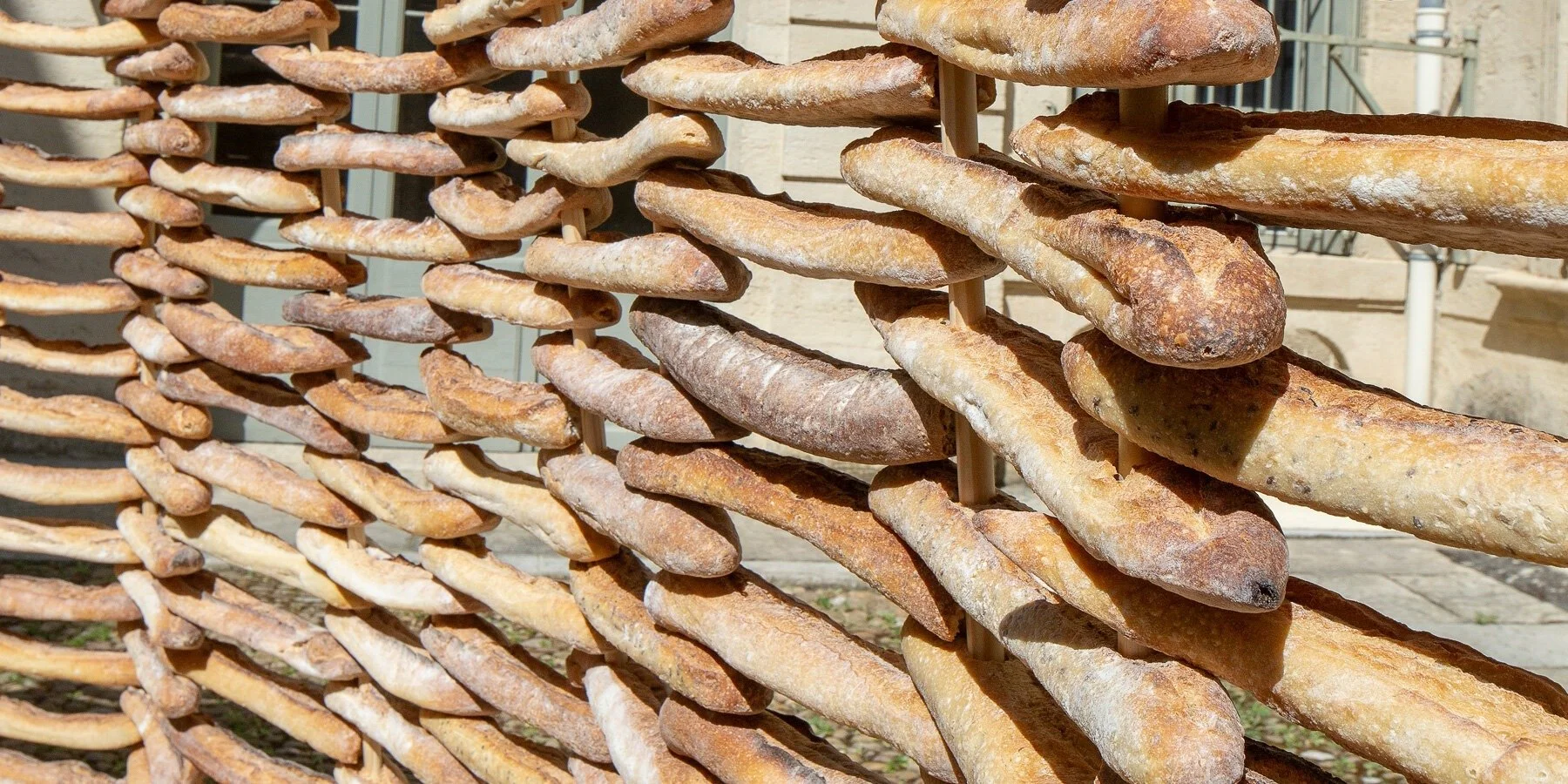
The project uses the tension between bread’s cultural significance and the destruction of unsold loaves to explore how architecture can make waste tangible, embodied in a porous wall of cracked crust.
Two further routes prevent the comparison from becoming a simple choice between intact matter and foam. Melih Güzel's study, first published online in 2024, hydrolyses bread into a substrate for bacterial cellulose production. The carbohydrate changes chemical identity through biosynthesis. In a separate 2026 study by Yagmur Bektas and colleagues, yeast, cellulose, alginate and glycerol form printable architectural materials. The latter uses baker's yeast; it does not demonstrate that discarded bread or waste yeast can be substituted without further development. Both routes widen the design space while adding process requirements.
The table below compares these alternatives without implying that they produce equivalent products.
Performance evidence has to stay attached to its specimen. In wastepaper foam research, the 2023 study reports thermal conductivity of 0.044 W m⁻¹ K⁻¹; Thabitha Zelin Rachel V and Muthukumar Karuppan's 2026 paper reports 0.04–0.06 W m⁻¹ K⁻¹ for newspaper/PVA/chitosan formulations. The overlap is useful context, but does not rank the processes: composition, density and conditioning differ. Neither value belongs to Paper Blind. A defensible comparison would match the required function and test conditions before comparing a result per kilogram or per component.
A similar caution applies to softness. Elina Pääkkönen and colleagues' 2024 study examines compression and recovery across a large set of foam-formed cellulose materials. Its kraft and chemithermomechanical pulps provide a mechanistic comparator, rather than evidence about recycled content. For design, the interesting implication is that a porous network has a loading history. A material that compresses conveniently on first contact may recover differently after repeated use. Strength alone cannot describe that experience.
Human senses can help formulate the next experiment. The folded sheet might produce a sound as it moves; a fingertip could register a crease that an image smooths away. Bread brings remembered taste into the encounter before anyone touches it. Smell, if present, would change the distance at which the work is perceived. These are plausible channels of experience, not a record of handling either project. They suggest that functional characterisation should include the effort, friction, sound and odour through which people judge whether a material remains welcome in use.
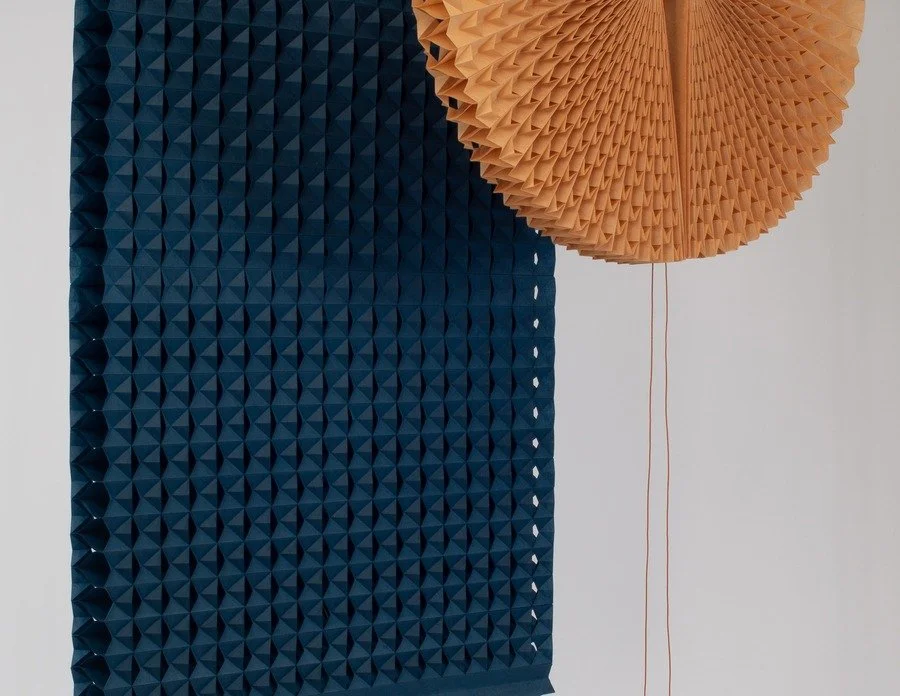
Paper Blind transforms paper’s fragility into adaptable strength, using replaceable parts to achieve domestic longevity.
A useful experimental programme would therefore begin with architecture. Optical imaging and three-dimensional scanning could measure fold angles and gaps. Micro-computed tomography could examine larger internal voids, while electron microscopy could locate damaged fibre contacts or collapsed pore walls. Gas adsorption would address accessible fine porosity, with its pretreatment documented. These methods describe different parts of the structure. None should be treated as a substitute for observing the whole component under its intended conditions.
The second step would connect those observations to function. For a blind, measure light transmission and glare alongside operating force and repeated adjustment. For reconstructed porous materials, measure density, thermal conductivity and compression recovery under controlled humidity. Spectroscopy and thermal analysis could track formulation- and processing-related changes. A sensory panel could then compare how the same conditioned specimens feel and sound. Instrumental measurements would make it possible to ask why a reported sensation changes, instead of treating an evocative adjective as a material property.
The limitations are also economic and environmental. A dry-looking object may have required substantial water removal. An easily replaced panel may still be replaced too often. A laboratory's low-cost drying route is not automatically the lowest-impact route at another scale. For bread, a material application must also be considered besides feasible food redistribution and other local uses. A life cycle assessment would need the actual collection, processing, transport, useful life and disposal system. Recovered origin alone cannot settle that comparison.
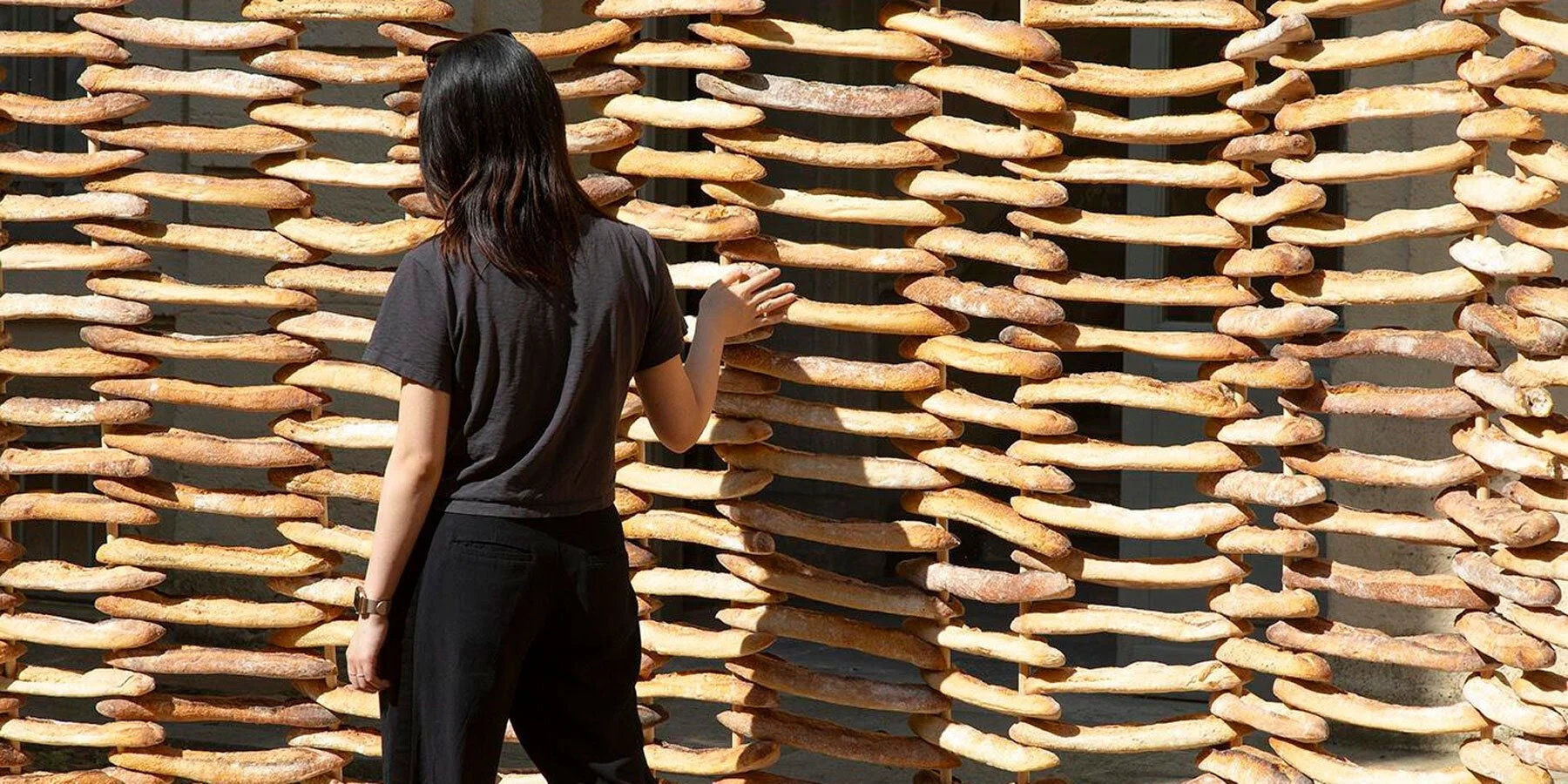
Paysage de Pain uses a public pavilion made of bread to reveal how nourishment and waste give rise to each other, making the ethics of abundance visible through discarded matter.
One promising research direction is to study the void's useful life. A fold may gradually lose its angle; a foam may densify; a pore network may shrink as it dries. The research question is when those changes begin to impair the function people need. Tracking geometry and performance together would reveal whether a treatment preserves a useful architecture or merely increases a headline strength value. For moving sheets, a particularly valuable result would be reliable light control over repeated operations with a small material demand.
A second direction would bring perception into that service-life model. Researchers could compare the cycle at which a component fails a functional threshold with the cycle at which people want to replace it. A change in noise or operating force might matter before a tear appears. Conversely, people might accept visible ageing if the component still works well. Such a study would test whether sensory acceptance extends use or accelerates replacement; either result would matter for a circular design claim.
The two works leave a useful task for materials research: specify the space, the service and the time together. A crease needs to keep organising daylight for as long as the blind is needed. Reconstructed bread needs a pore architecture appropriate to its next job, with processing justified by that job. At the window, the question can return to a small action: a hand draws the cord, the folds shift, and a narrow shadow settles into its new position. The material has done something useful with the space it holds.
Bibliography
Art & Materials Lab (2026a). [Paper Blind — Natchar Sawatdichai](https://www.artandmaterialslab.com/materials/paper-blind). 13 May.
Art & Materials Lab (2026b). [Paysage De Pain — MERO Studios](https://www.artandmaterialslab.com/spatial/paysage-de-pain-mero-studios). 4 May.
MERO Studios (n.d.). [Paysage De Pain](https://mero-studios.com/paysage-de-pain). Studio project record; identifies the 2025 festival commission.
Festival des Architectures Vives (2025). [Paysage de Pain — MERO Studios](https://festivaldesarchitecturesvives.com/fav/mero-studios/). Organiser's project record.
Di Luigi, M., An, L., Armstrong, J.N. and Ren, S. (2022). Scalable and robust silica aerogel materials from ambient pressure drying. Materials Advances, 3, 2726–2736. [DOI 10.1039/D1MA01086G](https://doi.org/10.1039/D1MA01086G).
Zhang, B. et al. (2023). Biodegradable Wastepaper-Based Foam with Ultrahigh Energy-Absorbing, Excellent Thermal Insulation, and Outstanding Cushioning Properties. ACS Sustainable Chemistry & Engineering, 11(49), 17543–17551. [DOI 10.1021/acssuschemeng.3c06230](https://doi.org/10.1021/acssuschemeng.3c06230).
Güzel, M. (2025; first online 26 April 2024). Valorisation of bread wastes via the bacterial cellulose production. Biomass Conversion and Biorefinery, 15, 4777–4790. [DOI 10.1007/s13399-024-05662-7](https://doi.org/10.1007/s13399-024-05662-7).
Pääkkönen, E., Ketoja, J.A. and Paltakari, J. (2024). Energy absorption and resilience in quasi-static loading of foam-formed cellulose fibre materials. Cellulose, 31, 7137–7152. [DOI 10.1007/s10570-024-06030-4](https://doi.org/10.1007/s10570-024-06030-4).
Guo, W., Budtova, T. and Martinez, M.M. (2025). Upcycling stale bread into (meso)porous materials: Xerogels and aerogels. Food Hydrocolloids, 160(Part 1), 110807. [DOI 10.1016/j.foodhyd.2024.110807](https://doi.org/10.1016/j.foodhyd.2024.110807).
Kankkunen, T. and Niiranen, J. (2025). Folding pristine paper to an origami structure – materially and geometrically nonlinear finite element analysis. European Journal of Mechanics A: Solids, 112, 105674. [DOI 10.1016/j.euromechsol.2025.105674](https://doi.org/10.1016/j.euromechsol.2025.105674).
Thabitha Zelin Rachel V and Muthukumar Karuppan (2026). Biodegradable foam from wastepaper with enhanced hydrophobicity for thermal insulation applications. Chemical Engineering Science, 321(Part A), 122725. [DOI 10.1016/j.ces.2025.122725](https://doi.org/10.1016/j.ces.2025.122725). Author names retained in the publisher's displayed order.
Bektas, Y., Zboinska, M.A., Geijer, C., Nypelö, T. and Hefny, Z. (2026). Novel 3D-printable yeast-based materials for architectural applications. Frontiers of Architectural Research, 15(6), 2337–2356; first online 5 March. [DOI 10.1016/j.foar.2026.01.003](https://doi.org/10.1016/j.foar.2026.01.003).
Guo, W., Spotti, M.J., Portillo-Perez, G., Bonilla, J.C., Bai, W. and Martinez, M.M. (2024). Molecular changes and interactions of wheat flour biopolymers during bread-making: Implications to upcycle bread waste into bioplastics. Carbohydrate Polymers, 342, 122414. [DOI 10.1016/j.carbpol.2024.122414](https://doi.org/10.1016/j.carbpol.2024.122414).
Responsible Editor
Mark Jackson