After the Cut, What Holds?
The first thing to notice is not the scissors, although they hang above Beili Liu's The Mending Project like weather about to break. It is the cloth on the floor: white pieces cut by visitors, taken to the seated performer, then joined with black thread. The stitching does not pretend the cut never happened. It thickens around it. Each seam makes a small ridge, a drawn line with tension, until the fabric becomes less like a sheet and more like a record of interruptions.
That is the material question running through these four works: after something has been cut, spent, discarded or displaced, what kind of holding is still possible? Not restoration in the tidy sense. Not the fantasy that waste can be made innocent by a clever design gesture. Holding, here, means the harder work of keeping damage in view while asking the matter to serve again.
Liu's installation is the most direct lesson in this. Art & Materials Lab entry describes 1,500 Chinese iron scissors suspended point-down, with a woman continuously mending beneath them. The work depends on an uncomfortable division of roles. Viewers cut; the performer repairs. The black thread does not simply heal the white cloth, because the cut is repeated again and again as part of the piece. Repair becomes labour under threat, a quiet act carried out below a dark metal canopy. Elizabeth Spelman's writing on repair is useful here because she treats fixing not as a sentimental return to wholeness, but as an everyday response to a fragile world. Liu gives that impulse a body, a posture and a pace.
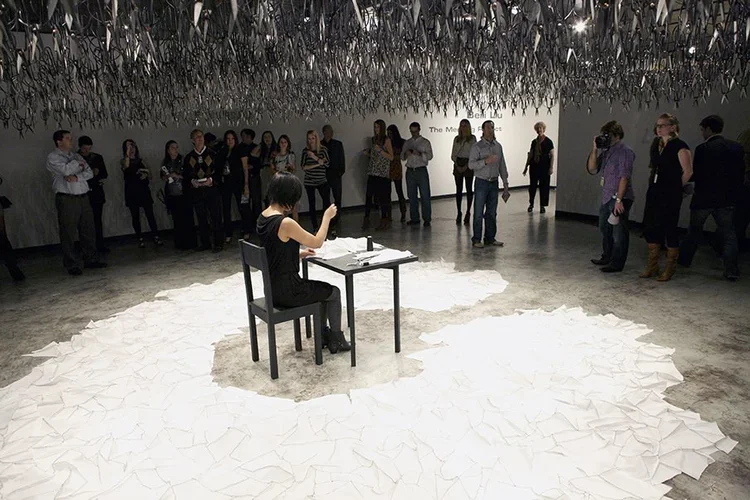
The Mending Project by Beili Liu
FabBRICK begins from a different kind of cut cloth: the unwanted textile already separated from use. Clarisse Merlet's studio compresses discarded garments and fabric into brick-like modules for interiors, furniture and lighting. The attraction of the material is partly visual. The colour is not applied as a decorative finish; it is inherited from the source textiles. A brick may carry flecks, fibres and blended tones that still suggest previous lives as clothes. Yet compression changes the ethics of looking. Loose fabric invites touch and drape; compressed fabric asks to be read as mass. It becomes a unit, something stackable, panelled, counted.

FabBRICK by Clarisse Merlet
The Ellen MacArthur Foundation's 2017 report on textiles argues that clothing has become increasingly disposable and that fabric and fibres need to circulate at higher value after use. FabBRICK sits inside that ambition, but it also exposes one of its tensions. Circularity is not magic. A textile brick still needs binding, fabrication, labour, testing, transport and an honest account of where it can and cannot perform. Its interest lies less in the claim that waste has disappeared than in the way waste remains legible. The brick does not erase the garment. It disciplines it.

The Green Island by Estudio Cavernas
The Green Island by Estudio Cavernas shifts the scale from object to settlement. Built for Burmese migrants living at a municipal waste centre in Mae Sot, Thailand, the project is described by Art & Materials Lab as a multipurpose community space made with local construction training, reclaimed timber, sugarcane thatch, aluzinc layers and drainage strategies. Here repair cannot be reduced to a material sample. It is spatial, climatic and social. A raised floor answers flood risk. Thatch and shade answer heat. Reclaimed wood carries the marks of earlier use, but its value is measured by whether children can gather, learn and play under it.
This is where the word sustainability needs care. In architecture, a reused material can still fail if it is poorly detailed, unsafe, or forced into a climate it cannot handle. The Green Island is persuasive because the material choices are described alongside construction knowledge: training over two years, local techniques, drainage, shade, ventilation, and a structure adapted to a vulnerable site. The work asks less glamorous questions than a product launch. Who can maintain this? Who knows how it was made? What happens during rain? What does a building owe to people whose daily environment is already organised around waste?
Chitofoam brings the argument into a stranger register. Developed by Charlotte Böhning and Mary Lempres, it is presented as a foam-like packaging material made from chitin drawn from mealworm exoskeletons, in relation to mealworms' capacity to consume polystyrene. Chitin is not an exotic invention. Marguerite Rinaudo's review in Progress in Polymer Science describes it as a major natural polymer, structurally present in arthropod exoskeletons and fungal cell walls, with chitosan as an important derivative. The point is not that insects offer a simple rescue from plastic. Research by Yang and colleagues on mealworms and polystyrene is promising precisely because it is specific: it concerns organisms, gut microorganisms, rates of degradation and chemical characterisation, not a blanket permission to keep producing foam.
As a design proposition, Chitofoam is strongest when read as a question rather than a finished answer. Packaging is meant to disappear from attention. It cushions, travels, protects and is thrown away. By making foam from an exoskeletal residue, Böhning and Lempres make the support material newly visible. The protective shell has already belonged to a body. It asks the user to imagine cushioning as something grown, shed and processed, rather than expanded from petrochemical abstraction.
Across the four works, residue is never just residue. Cloth becomes an index of harm and care in Liu's performance. Textile waste becomes a compressed architectural surface in FabBRICK. Salvaged and local materials become civic shelter in The Green Island. In Chitofoam, biological leftovers become a speculative substitute for a stubborn synthetic material. Each case changes the meaning of strength. Strength is not only hardness, permanence or technical novelty. Sometimes it is the capacity to accept a join. Sometimes it is the ability to carry social knowledge. Sometimes it is the discipline to admit that a material solution is partial.

Chitofoam by Charlotte Böhning and Mary Lempres
There is a useful discomfort in keeping these works together. The Mending Project is slow, intimate and almost unbearably human. FabBRICK is modular and entrepreneurial. The Green Island is infrastructural. Chitofoam is experimental and scientific. They do not agree on what repair should look like. That is why the comparison matters. It prevents repair from becoming a style. A stitch, a brick, a shelter and a foam sample can all belong to repair culture, but only if we ask what has been broken, who performs the fixing, and what new dependencies the repaired thing creates.
The final image, then, is not of waste transformed into beauty. That would be too easy. It is of a black thread pulled through white cloth while metal points hang overhead; of fabric crushed until it can stand upright; of timber lifted clear of floodwater; of a mealworm shell reconsidered as packaging. After the cut, nothing is pure. But some things still hold.
Bibliography
Art & Materials Lab (2024) 'The Mending Project - Beili Liu'. Available at: https://www.artandmaterialslab.com/art/the-mending-project-beili-liu (Accessed: 12 June 2026).
Art & Materials Lab (2024) 'The Green Island - Estudio Cavernas'. Available at: https://www.artandmaterialslab.com/spatial/the-green-island-estudio-cavernas (Accessed: 21 June 2026).
Art & Materials Lab (2024) 'Chitofoam - Charlotte Böhning & Mary Lempres'. Available at: https://www.artandmaterialslab.com/materials/chitofoam-charlottebhning-marylempres (Accessed: 22 June 2026).
Art & Materials Lab (2025) 'FabBRICK - Clarisse Merlet'. Available at: https://www.artandmaterialslab.com/materials/fabbrick-clarissemerlet (Accessed: 21 June 2026).
Ellen MacArthur Foundation (2017) 'A new textiles economy: Redesigning fashion's future'. Available at: https://www.ellenmacarthurfoundation.org/a-new-textiles-economy (Accessed: 22 June 2026).
FabBRICK (2025) 'Design textile'. Available at: https://www.fab-brick.com/ (Accessed: 21 June 2026).
Jackson, S.J. (2014) 'Rethinking repair', in Gillespie, T., Boczkowski, P.J. and Foot, K.A. (eds.) Media Technologies: Essays on Communication, Materiality, and Society. Cambridge, MA: MIT Press, pp. 221-239.
Rinaudo, M. (2006) 'Chitin and chitosan: Properties and applications', Progress in Polymer Science, 31(7), pp. 603-632. Available at: https://doi.org/10.1016/j.progpolymsci.2006.06.001 (Accessed: 22 June 2026).
Spelman, E.V. (2002) Repair: The Impulse to Restore in a Fragile World. Boston: Beacon Press.
Yang, Y., Yang, J., Wu, W.-M., Zhao, J., Song, Y., Gao, L., Yang, R. and Jiang, L. (2015) 'Biodegradation and mineralisation of polystyrene by plastic-eating mealworms: Part 1. Chemical and physical characterisation and isotopic tests, Environmental Science & Technology, 49(20), pp. 12080-12086. Available at: https://doi.org/10.1021/acs.est.5b02661 (Accessed: 22 June 2026).
Responsible Editor
Isabel Pavone