Material Breath: Locating Haptic Memories in Space
When we look deeply into a space, light stops being just a physical phenomenon passing through a transparent medium; instead, it settles on the rough surface of rice straw, is absorbed by irregular pores, or is bent by organic moisture at the growing edge of mycelium. This visual fuzziness and resistance make us abandon the desire to see everything instantly, prompting us to use our skin and bodies to feel the weight of particles floating in the air. This moment marks a transition from merely viewing to dwelling, an Ontological Confrontation—where silent fillers begin to breathe and extend their presence around us. We are living in an era marked by a crisis of smoothness: our fingers endlessly glide over glass screens, craving friction, while our bodies remain in sterilised, hermetic environments that block the passage of time. I believe that modern spatial design should go beyond visual form to create a "material breath," a dialectic where primitive haptic memories and emerging digital perceptions are not opposed but intertwined, composing the spiritual density of space.
The Roughness of History and Regional Resistance
In Sukchulmok’s Mok-04, Rice Straw & Jige, the material serves not just as decoration but as a powerful reminder of history, presented with intensity to the viewer. The artist reimagines rice straw—an element common in traditional Korean farming—by stacking it densely and weaving it into a rough skin that overlays a contemporary metal framework. These are not uniform industrial pieces; they are tangled, prickly, and may even carry the scent of burning or dampness from the fields, asserting a presence that occupies the space. When viewers try to approach, the straw's harsh texture causes physical discomfort, forcing them to pull back. This disrupts visual fluidity, invoking awe for the weight of history. The straw forms a boundary—not a wall, but a dense thicket of memory that resists easy explanation.
I reference Kenneth Frampton’s Critical Regionalism to deepen this discussion: he emphasises that resisting globalised, mediocre architecture depends on how materials reflect regional cultural sedimentation. Mok-04 challenges the sleek aesthetic of modernism through its rough texture, making the material a resilient fortress against forgetfulness. To clarify the creation of this fortress, I also draw on Tim Ingold’s concept of Correspondence from his 2013 book, Making. Ingold suggests that making involves not forcing a predetermined shape onto materials but engaging with their natural flow. The creator of Mok-04 did not simply apply straw; they had to surrender to its inherent tendencies—its directionality, brittleness, and resistance to bending. This process turns the piece from a static object into a record of the struggle between human touch and vegetal fibre. It is more than just straw; it becomes a spatial memory that emphasises the land’s enduring significance through each encounter with the observer.

Mok-04, Rice Straw & Jige by Sukchulmok
The Impermanence of Growth and the Philosophy of Symbiosis
If Mok-04 represents the coagulation of history, then Mizzi Studio’s The Living Bridge embodies the concept of material as a living entity that flows and metabolises. This bridge is not merely built from inert materials; instead, it is cultivated from mycelium and bamboo. Guided by a bamboo framework, the mycelium permeates every crevice, turning what is usually an artificial structure into a natural extension of the environment, all while maintaining a slow, determined biological rhythm. Formally, the bridge transcends the idea of a static object that obstructs visibility; it becomes a process that is actively unfolding. It avoids the pursuit of eternal stillness, instead embracing the cycles of decay and regeneration. The bridge's colour evolves naturally, shifting from creamy whites to earthy browns as the organism matures and reacts to the humidity of its surroundings.
As you walk through it, you are no longer just an outside observer; you become enveloped in a breathing, organic system that creates an intimate experience of being surrounded by life. I draw upon Timothy Morton’s concept of Hyperobjects to illustrate this change in scale: mycelium helps us understand that human architecture is not a fortress separate from nature, but a temporary state within a vast ecological network. Moreover, I reference Jane Bennett’s theory of Vibrant Matter to highlight the political implications of this vitality. Bennett posits that matter possesses thing-power, acting upon us just as we act upon it. In The Living Bridge, the material is not a passive substrate; it serves as a collaborator that requires specific conditions of care and moisture to thrive. This necessitates a shift in the "viewer experience" from passive consumption to a sense of stewardship. This breathing of materials gently yet radically deconstructs the architectural arrogance surrounding permanence, hinting at a future where buildings are grown, nurtured, and ultimately allowed to fade away.
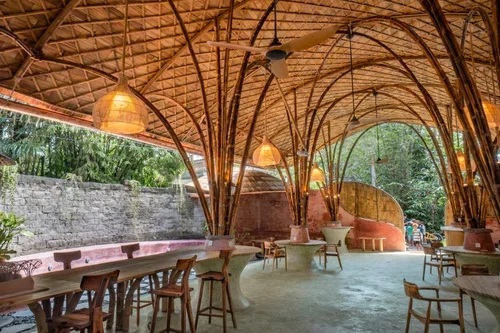
The Living Bridge Bamboo Building by Mizzi Studio
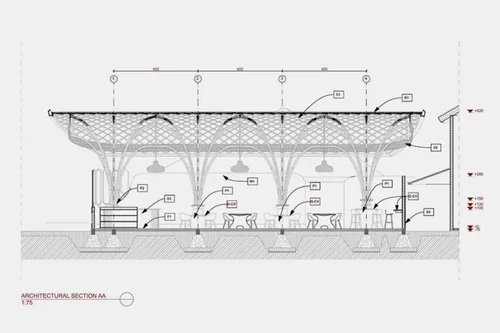
The Living Bridge Section Drawing by Mizzi Studio
The Extension of Organs and the Blurring of the Body
In shifting from macro-architecture to micro-furniture, Boyeon Kim and Jaehan Choi’s omni chair blurs the line between object and body in intriguing ways. This piece is not a chair in the conventional sense; rather, it is a modular structural system that mimics the qualities of biological tissue. The materials engage in a dynamic process of adaptation; metal joints and fabrics connect like muscle and bone, reorganising themselves to fit the user's posture. Instead of remaining static and waiting to be used, the chair actively embraces the user's body, transforming the act of sitting into a symbiotic relationship. It challenges the norms of modernist ergonomics by rejecting the "standardised body" narrative; it doesn’t insist that you sit up straight but instead invites you to determine how you wish to be supported.
The user's experience shifts from mere usage to an engaging dialogue, where the contours of the body merge with the chair's embrace. To bridge a cognitive gap, I draw on Juhani Pallasmaa’s insights in The Eyes of the Skin: modern design’s heavy reliance on visual aspects has led to a lack of tactile experience. The omni chair embodies Pallasmaa's vision of haptic architecture, emphasising that the core of space lies not in what we see but in the intimate, pre-linguistic interactions between body and material. It serves as a prosthetic extension of the self—a modular organ that reflects the body's intrinsic need for support and flexibility. By challenging the strict boundary between animate subjects and inanimate objects, it proposes a continuous feedback loop where the furniture "listens" to the occupant's movements and adjustments.
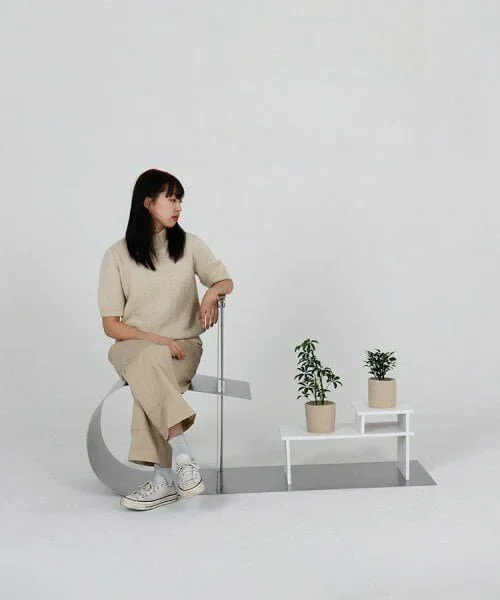
&omni by Boyeon Kim & Jaehan Choi
Digital Texture and the Illusion of Reciprocity
Finally, we must address the role of digital media in this material dialogue. Jade Tang’s Spaces of Reciprocity does not disregard physical entities; instead, it layers light, shadow, and screens onto living spaces as a new material. In this approach, digital imagery becomes more than just a virtual escape—it is superimposed onto physical surfaces, acting like a second skin. Light filters through semi-transparent media, creating an Overlay state where reality and virtuality meet, blurring the lines between spatial definitions. The projection doesn’t simply cover the wall; it engages with the wall's texture, crafting a hybrid surface that is neither entirely physical nor purely optical.
Within this environment, the viewer shifts between focusing on the tangible wall and becoming lost in the image's depth. I propose that this dynamic creates what I refer to as a Digital Patina. Much like rust accumulates on iron, data builds up in our spaces. This challenges the notion that digital space is essentially disembodied. Tang’s work illustrates that when light and data are grounded in a specific location, they take on mass and gravity, shaping an atmosphere that can be sensed—a mood that changes the room's temperature. This reciprocal relationship redefines materiality in the digital age: it’s not just about touchable atoms; photons and data streams carry a "weight" that occupies space and evokes emotional responses. It becomes an invisible breath, bridging the gap between physical space and psychological projection, demonstrating that the digital realm can indeed hold a sense of tactile memory—if only we fine-tune our senses to catch its subtle hum.
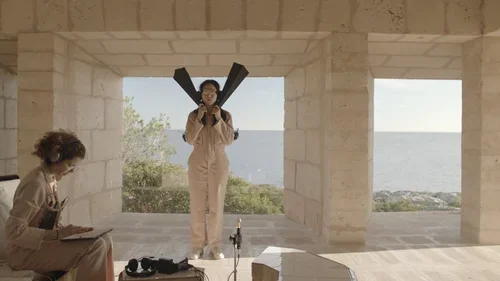
Spaces of Reciprocity by Jade Tang
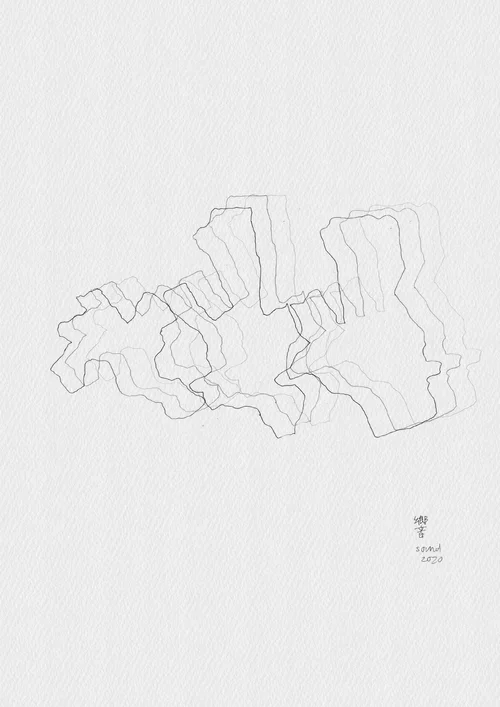
Spaces of Reciprocity Study Drawing by Jade Tang
Breathing Where the Dust Settles
When we trace the line from the roughness of straw to the growth of mycelium, through modular organs to digital overlays, a clear thread emerges: material is never a silent, dead observer. This is not merely a question of how to build, but an ethics of perception. In this overly smooth, retina-dominated world, we are at risk of sensory numbness. We urgently need these "breathing" materials to anchor our existence and to remind us of our own biological vulnerability.
The argument of these materials is one of resistance—resistance to the flattening of experience, to the speed of consumption, and to the forgetting of our ecological origins. When the last ray of light falls on the jagged tips of the straw in Mok-04, catching the dust motes dancing in the air, or as The Living Bridge silently releases spores into the wind, we finally understand that the soul of space is awakened in these tiny, haptic moments. That is the breath of material, and the sound of our own memories settling. It is here, in the texture of the world, that we find the evidence that we are still alive.
Bibliography
Bennett, J. (2010). Vibrant Matter: A Political Ecology of Things. Durham: Duke University Press.
Boyeon Kim & Jaehan Choi (2023). &omni chair, Art and Materials Lab, 2 Jun. Available at: Art and Materials Lab (Accessed: 4 December 2025).
Frampton, K. (1983). 'Towards a Critical Regionalism: Six Points for an Architecture of Resistance', in Foster, H. (ed.) The Anti-Aesthetic: Essays on Postmodern Culture. Port Townsend: Bay Press, pp. 16-30.
Ingold, T. (2013). Making: Anthropology, Archaeology, Art and Architecture. London: Routledge.
Mizzi Studio (2021). The Living Bridge, Art and Materials Lab, 24 October. Available at: Art and Materials Lab (Accessed: 12 December 2025).
Morton, T. (2013). Hyperobjects: Philosophy and Ecology after the End of the World. Minneapolis: University of Minnesota Press.
Pallasmaa, J. (2005). The Eyes of the Skin: Architecture and the Senses. Chichester: Wiley-Academy.
Sukchulmok (2023). Mok-04, Rice Straw & Jige, Art and Materials Lab, 11 August. Available at: Art and Materials Lab (Accessed: 11 December 2025).
Tang, J. (2022). Spaces of Reciprocity, Art and Materials Lab, 19 October. Available at: Art and Materials Lab (Accessed: 14 December 2025).
Responsible Editor
Ethan Liu